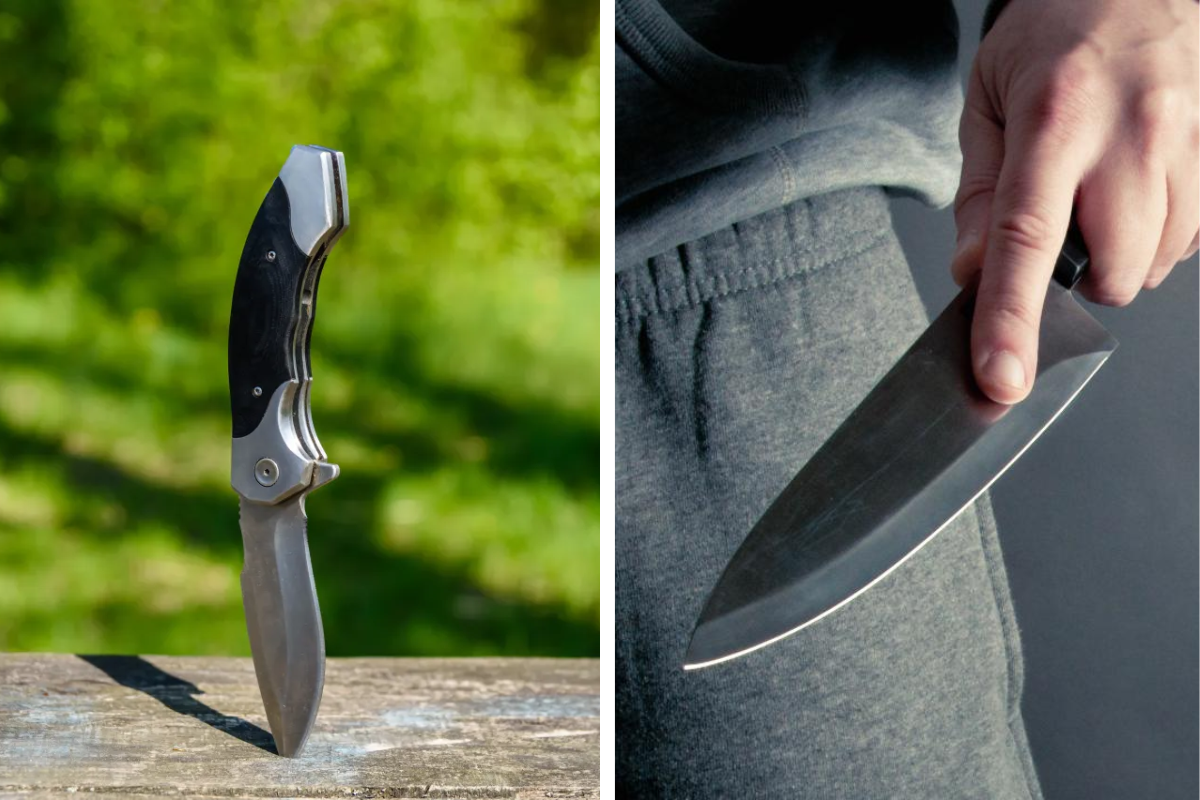
Rhode Island allows broad knife ownership but sharply limits how certain knives can be carried, especially concealed. If you carry a pocketknife, utility tool, or folder for everyday tasks, the rules are relatively permissive; if you want to carry something larger or more “weapon‑like,” you must pay close attention to open‑ versus concealed‑carry rules and local restrictions.
What you can own
In Rhode Island, it is legal to own almost any knife, including dirks, daggers, stilettos, sword‑cane blades, Bowie knives, butterfly knives, and switchblades, as long as you do not intend to use it unlawfully against another person. The main ownership exception is anything that also qualifies as metal knuckles or brass knuckles (for example, trench knives with finger rings), which are illegal to possess.
You may buy, sell, manufacture, gift, or inherit these knives without violating state law, provided the conduct does not involve criminal intent or prohibited persons (such as felons in some cases).
Concealed‑carry restrictions
Rhode Island’s biggest restriction focuses on concealed carry, not ownership. Under R.I. Gen. Laws § 11‑47‑42:
- It is illegal to carry concealed a dirk, dagger, stiletto, sword‑cane, Bowie knife, or any knife with a blade more than 3 inches long (measured from the handle‑to‑blade junction to the tip).
- The only common exception is a plain folding pocketknife with a blade 3 inches or shorter, which can be concealed.
In practice, this means you can own a 4‑inch folder or a fixed‑blade survival knife, but you cannot hide it on your person; you can, however, open‑carry it in most non‑restricted areas as long as it is not used unlawfully.
Open carry and where knives are banned
Rhode Island does not set a statewide blade‑length limit for open carry, and open‑carry of most knives is legal outside of specific prohibited places. However, local rules change the picture sharply:
- Knives are banned in many public buildings, including courthouses, police stations, and some state offices, where any bladed weapon may be treated as a prohibited weapon.
- Schools, colleges, and public‑transit facilities often have their own rules excluding knives of any length, even if state law would otherwise allow them.
Always check signs and local ordinances before entering restricted zones; in those places, a “legal” knife under state law can still get you arrested or removed from the premises.
Using a knife in a crime
Carrying a knife in a lawful, non‑threatening way is generally fine; using it during a crime is not. Under R.I. Gen. Laws § 11‑47‑59, it is a serious felony to commit or attempt any crime of violence while possessing a knife with a blade longer than 3 inches, with penalties of 1–5 years in prison and fines up to $3,000.
Even if your knife is otherwise legal, brandishing it in a threatening or assaultive manner can turn simple possession into assault‑ or weapon‑related charges.
Practical tips for Rhode Island residents
- For concealed carry: Stick to a folding pocketknife with a 3‑inch or shorter blade if you want to keep it hidden.
- For larger or “weapon‑like” knives: Use them openly (holstered on a belt, in a sheath outside clothing), avoid schools, courthouses, and secure public buildings, and never carry with intent to intimidate or harm.
- When in doubt: Check local ordinances and facility rules; if you are unsure whether a knife is allowed somewhere, it is safer to leave it at home.
SOURCES :
- https://knifeup.com/rhode-island-knife-laws/
- https://www.knifeden.com/knife-laws-in-rhode-island/