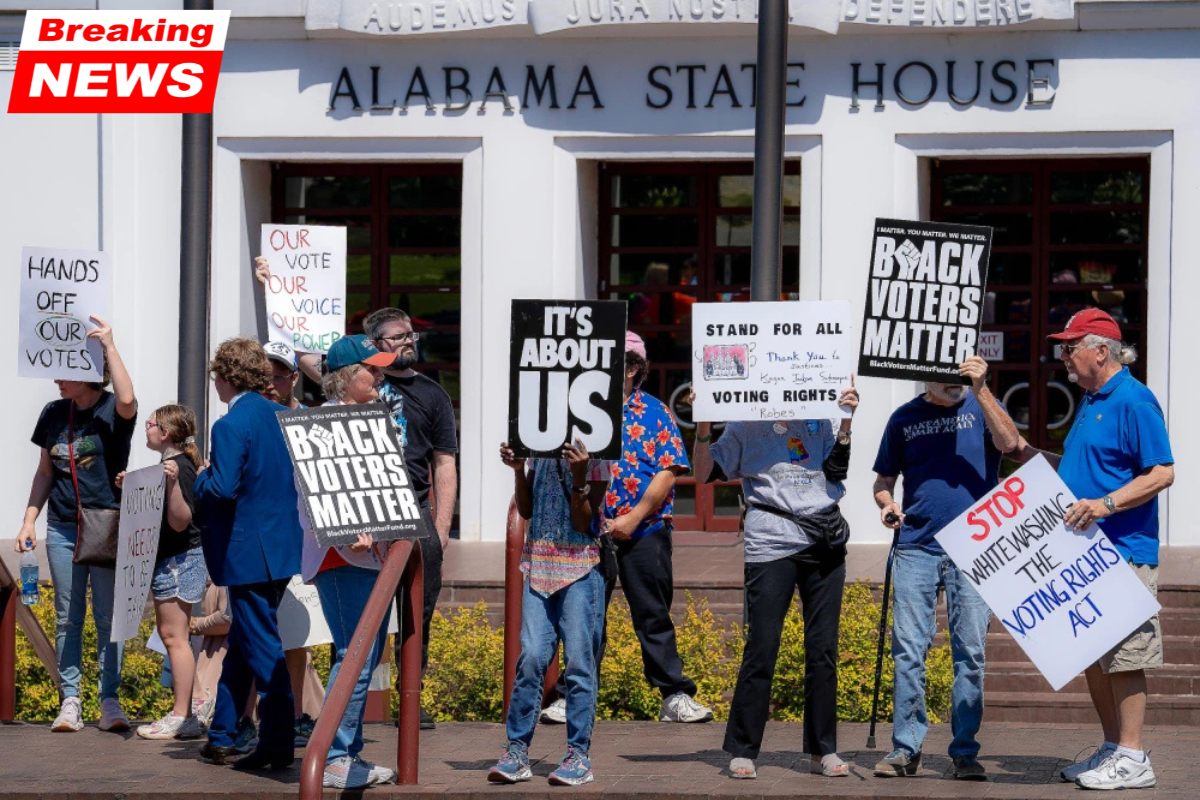
Alabama Governor Kay Ivey has signed a critical piece of legislation on Friday that could lead to new primary elections if courts allow Republicans in the state to revise their congressional and state Senate maps before the November midterms.
New Legislation and its Potential Impact on Primary Elections
Alabama’s primaries are currently scheduled to take place under its existing congressional maps on May 19.
However, the new legislation signed by Ivey gives the Republican-controlled Legislature the power to schedule special primary elections for certain districts if redrawn maps are approved by the courts.
This move marks a significant shift in the state’s political landscape ahead of the highly anticipated November elections.
The changes to the district maps come in the wake of a U.S. Supreme Court ruling on Louisiana’s redistricting case that restricted the use of race in creating district boundaries.
Building on that ruling, Alabama Republicans have asked a federal court to allow them to replace the current court-ordered map, which includes two majority-minority districts represented by Democrats, with a new map approved by the Legislature in 2023 that contains only one such district.
Background on Alabama’s Redistricting Dispute
The dispute traces back to a 2023 federal court ruling that required Alabama to adopt a new congressional map that would provide better representation for Black voters.
Under the court’s ruling, the state must have one majority-Black district in the 7th Congressional District and one “opportunity” district in the 2nd Congressional District, where Black residents represent a plurality.
Despite the ruling, Alabama Republicans have pushed for a new map that they argue is more representative of the state’s current political landscape. Their proposed map, which was approved by the Legislature in 2023, would reduce the number of majority-minority districts from two to one.
In response, Alabama Republicans have filed a request with the U.S. Supreme Court to allow the new map to take effect before the midterms.
The legal challenges surrounding the redistricting process reflect broader political tensions and the strategic importance of redistricting ahead of the elections, where control of the U.S. House of Representatives is at stake.
Southern States’ Push for Favorable Maps
The move by Alabama is part of a broader push by southern states to redraw district lines in a way that benefits Republican control, using recent Supreme Court decisions to justify the changes.
In Tennessee, Governor Bill Lee recently signed a new congressional map into law that reconfigures the state’s lone majority-Black and Democratic-held House district.
Meanwhile, in Louisiana, Republicans have delayed their May 16 House primaries to redraw district boundaries after their proposed map was struck down. South Carolina lawmakers are also considering new redistricting proposals.
These efforts come as Republicans in southern states seek to strengthen their political power in the lead-up to the 2026 elections. With control of the U.S. House hanging in the balance, the redistricting battles are expected to intensify in the coming months.
Republican Reaction and Opposition
Republican leaders in Alabama have defended the push to redraw the maps. State House Speaker Nathaniel Ledbetter described the current map as a “racially gerrymandered disgrace” and expressed confidence that the new maps would help Republicans regain control of the state’s Second Congressional District, which he believes was “wrongfully handed to Democrats by the courts.” He also noted that the Seventh Congressional District could become a competitive race in the future.
Ledbetter’s statement reflects a broader Republican strategy to reclaim districts that have been historically held by Democrats, especially those with significant Black voter populations.
However, the move has been met with strong opposition from Democratic lawmakers, who argue that the redistricting efforts undermine the principles of fair representation and democracy.
State Senator Vivian Davis Figures, the mother of Representative Shomari Figures, one of the Democrats currently holding a seat in Alabama’s majority-minority districts, voiced concerns about the political implications of the new legislation.
“Today we are not debating maps, we are debating democracy itself,” she said. “We’re debating whether power matters more than principle.”
The Future of Alabama’s Redistricting and the Midterms
As the case continues to unfold in the courts, the impact of this legislation on the November 2026 midterm elections remains uncertain.
If the redrawn maps are approved, Alabama could see new primary elections under the revised districts, potentially altering the political landscape and shifting power in Congress.
The outcome of this legal and political battle could have significant implications for the balance of power in the U.S. House of Representatives.