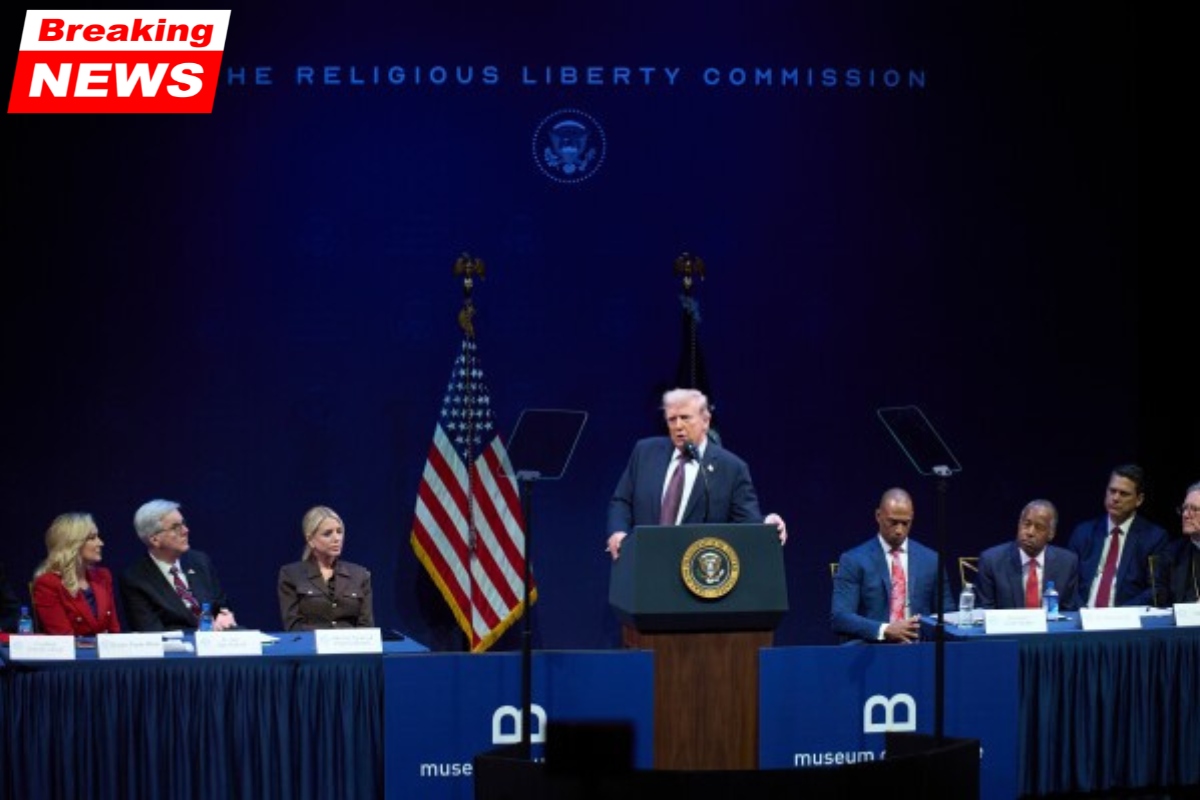
A series of contentious proposals by members of the advisory panel formed by former President Donald Trump has drawn both support and criticism. The recommendations, which reflect the conservative Christian views of many of the commission’s members, include calls for a Presidential Medal of Freedom for a baker who refused to create a wedding cake for a same-sex couple, court interventions by the Department of Justice for Amish parents challenging New York vaccine requirements, and even a federal hotline with the message, “There is no separation of church and state.”
These recommendations highlight the ongoing debate over religious liberty and its boundaries in American public life. The commission’s final report is still in progress, but the public revelations from its April meeting have already sparked significant controversy.
Key Proposals and Recommendations
The recommendations presented by the commission members emphasize expanding religious expression in various public sectors, including schools, workplaces, and government entities. Some of the key proposals include:
- Presidential Medal of Freedom for the Baker: One commission member called for the baker who refused to make a wedding cake for a same-sex couple to receive the prestigious medal. This is in line with the commission’s broader focus on protecting religious-based exemptions from anti-discrimination laws.
- Department of Justice Interventions: Members suggested that the DOJ intervene in cases involving religious groups and individuals fighting state regulations. Notably, the commission wants the DOJ to support Amish parents challenging vaccine requirements in New York and Catholic nuns fighting state mandates regarding gender identity accommodations for hospice patients.
- Federal Hotline: The chair of the Religious Liberty Commission, Dan Patrick, proposed creating a federal hotline that would include an automated message asserting that “there is no separation of church and state,” a statement that runs counter to the long-established understanding of the First Amendment.
Criticism of the Commission’s Views
While many conservatives support the commission’s stance, critics argue that its recommendations promote a one-sided view of religious liberty that ignores the constitutional separation of church and state. Progressive groups, including a coalition of interfaith organizations, have filed a lawsuit alleging that the commission fails to meet the federal law’s requirement for diverse membership and viewpoints.
Critics point out that most of the commission’s members are conservative Christian leaders, with one Orthodox Jewish rabbi included. The commission’s meetings have largely taken place at the Museum of the Bible in Washington, a Christian-led institution, further fueling concerns about bias.
These critics also argue that the commission has largely focused on the grievances of conservative Christians, while neglecting issues such as anti-Muslim sentiments, the rise of antisemitism on the right, and religious discrimination outside the Christian community.
Debate Over Church-State Separation
One of the most controversial aspects of the commission’s recommendations is its challenge to the principle of church-state separation. Dan Patrick, the commission chair and Texas Lieutenant Governor, has repeatedly denounced the idea of a “wall of separation” between church and state, a concept long upheld by the Supreme Court.
While the phrase “separation of church and state” is not explicitly stated in the Constitution, the Supreme Court has cited Thomas Jefferson’s interpretation of the First Amendment as establishing such a separation.
The court’s decisions have consistently emphasized that the government cannot endorse or support any religion, including through the establishment of a national religion.
Patrick’s comments have raised concerns among those who worry that the commission’s proposals could lead to government-sponsored religious practices, especially in public schools and government-funded institutions.
He has advocated for prayer in schools and the posting of Ten Commandments in public spaces, framing these efforts as necessary to “push back” against secular influences he believes are trying to remove religious expression from public life.
Commission’s Focus on Religious Exemptions
Another core aspect of the commission’s recommendations is the expansion of religious exemptions in areas such as healthcare, employment, and education. For example, the commission has called for:
- Exemptions for religious groups: Allowing faith-based organizations like Catholic Charities to receive federal funds without compromising their traditional religious teachings on issues like marriage and family.
- Military Religious Freedom: Some commissioners have advocated for reinstating full pay and benefits for service members discharged for refusing the COVID-19 vaccine, citing religious objections.
- Protection for Religious Expression: The commission has proposed requiring public schools and workplaces to post notices about the right to religious expression and exemptions, and ensuring religious groups have legal support in cases of perceived discrimination.
Tensions Within the Commission
While the commission has largely presented a unified front, there was one notable exception in February when Carrie Prejean Boller, a commissioner, was ousted after a heated discussion on antisemitism.
Prejean Boller was criticized for defending controversial figures and for her exchanges with witnesses at a hearing on the subject.
The episode highlighted the tensions within the commission, which often revolves around a mix of deeply held religious beliefs and the push for broader religious freedoms.
Conclusion: The Future of Religious Liberty in America
The Religious Liberty Commission’s recommendations highlight a growing movement among conservative Christians to increase religious expression and exemptions, particularly in the public sector. However, the commission’s narrow focus on certain religious perspectives and its challenge to the separation of church and state have raised concerns about the future of religious freedom in the U.S. as a whole.
As the debate continues, it remains to be seen whether these recommendations will gain traction within the broader political landscape, or whether the ongoing lawsuit and opposition from progressive groups will lead to significant changes in the commission’s composition and direction.