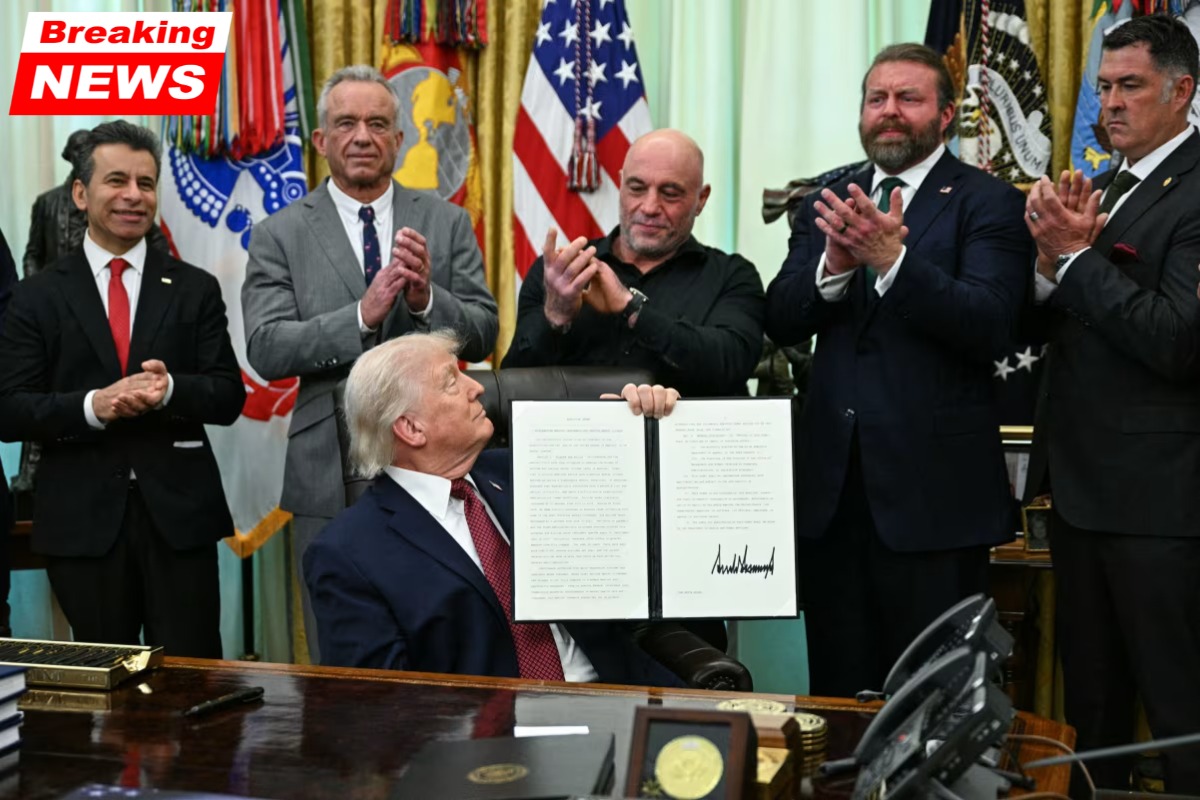
The relationship between Joe Rogan and Donald Trump is becoming increasingly difficult to ignore. What might look like a casual connection between a podcast host and a politician actually reveals something deeper about influence, loyalty, and political strategy.
The Ibogaine Story and Fast-Tracked Policy Influence
Rogan recently shared a striking story during an Oval Office appearance. According to him, a simple text message to Trump about expanding research into psychedelic treatments like Ibogaine led to an immediate positive response.
“Sounds great! Do you want FDA approval? Let’s do it!”
While the anecdote may sound exaggerated or simplified, it highlights how quickly ideas can move when they come from influential voices. It also suggests Rogan’s access to Trump goes beyond that of a typical media figure.
Criticism of Trump’s Iran War Policy
Despite this apparent closeness, Rogan has not held back in criticizing Trump’s handling of the conflict involving Iran.
On multiple occasions, he described the war as:
- “Insane based on what he ran on”
- “Why a lot of people feel betrayed”
- “F**king terrifying”
Rogan’s criticism focuses on a key contradiction: Trump campaigned heavily on ending wars, yet is now associated with a major military conflict.
Why Rogan Is Treated Differently
Many public figures who have criticized Trump — including Tucker Carlson, Megyn Kelly, Candace Owens, and Alex Jones — have faced sharp responses.
Rogan, however, has been treated with notable restraint.
Instead of attacking him, Trump has:
- Praised Rogan publicly
- Highlighted their past interview
- Emphasized Rogan’s massive audience reach
At one event, Trump even called Rogan “a fantastic person,” despite the ongoing criticism.
The Audience Factor: Why Rogan Matters
One key reason for this softer approach may be Rogan’s audience.
Unlike traditional conservative commentators, Rogan’s listeners are often:
- Less politically aligned
- More independent or undecided
- Recently drawn into Trump’s base
Trump himself referenced the scale of Rogan’s platform, noting their 2024 interview reached over 300 million viewers. Rogan’s endorsement before the election also played a role in expanding Trump’s appeal.
This makes Rogan uniquely valuable — and potentially risky.
Political Risk and the Iran War
Polling suggests that while many core supporters back Trump’s actions, a significant portion of his voters are uncertain or uneasy about the war.
Some estimates indicate:
- Up to 1 in 4 voters may not support the conflict
- Others are only lukewarm in their approval
Rogan’s criticism amplifies this concern because it reaches exactly the type of voters who may reconsider their support.
A Strategic Balancing Act
Trump’s approach to Rogan appears calculated. Rather than confronting him, he seems to be:
- Maintaining goodwill
- Avoiding alienating Rogan’s audience
- Keeping a key influencer within reach
This is very different from how Trump typically handles dissent, especially from those he expects loyalty from.
Not a Traditional Political Ally
Another factor is that Rogan isn’t deeply rooted in partisan politics. Trump himself described him as “a little bit more liberal.”
That distinction matters.
Figures like Carlson or Kelly are seen as part of the conservative ecosystem, where loyalty is often expected. Rogan operates outside that system, making his support more voluntary — and more fragile.
Key Takeaways
| Factor | Insight |
|---|---|
| Relationship | Friendly despite criticism |
| Conflict | Rogan strongly opposes Iran war |
| Trump’s Response | Praises Rogan instead of attacking |
| Audience | Large, independent, politically mixed |
| Risk | Potential loss of newer voters |
| Strategy | Maintain influence, avoid backlash |
The dynamic between Joe Rogan and Donald Trump shows how modern political influence is shifting. Traditional party figures no longer hold all the power. Independent voices with massive platforms can shape public opinion in ways that even presidents must consider carefully.
Trump’s unusually measured response to Rogan’s criticism suggests he recognizes that reality. Whether this relationship holds or fractures may depend on how the political landscape evolves, especially as elections approach.
What’s clear is that in today’s media environment, influence doesn’t always come from inside politics — and that can change how power is exercised at the highest levels.