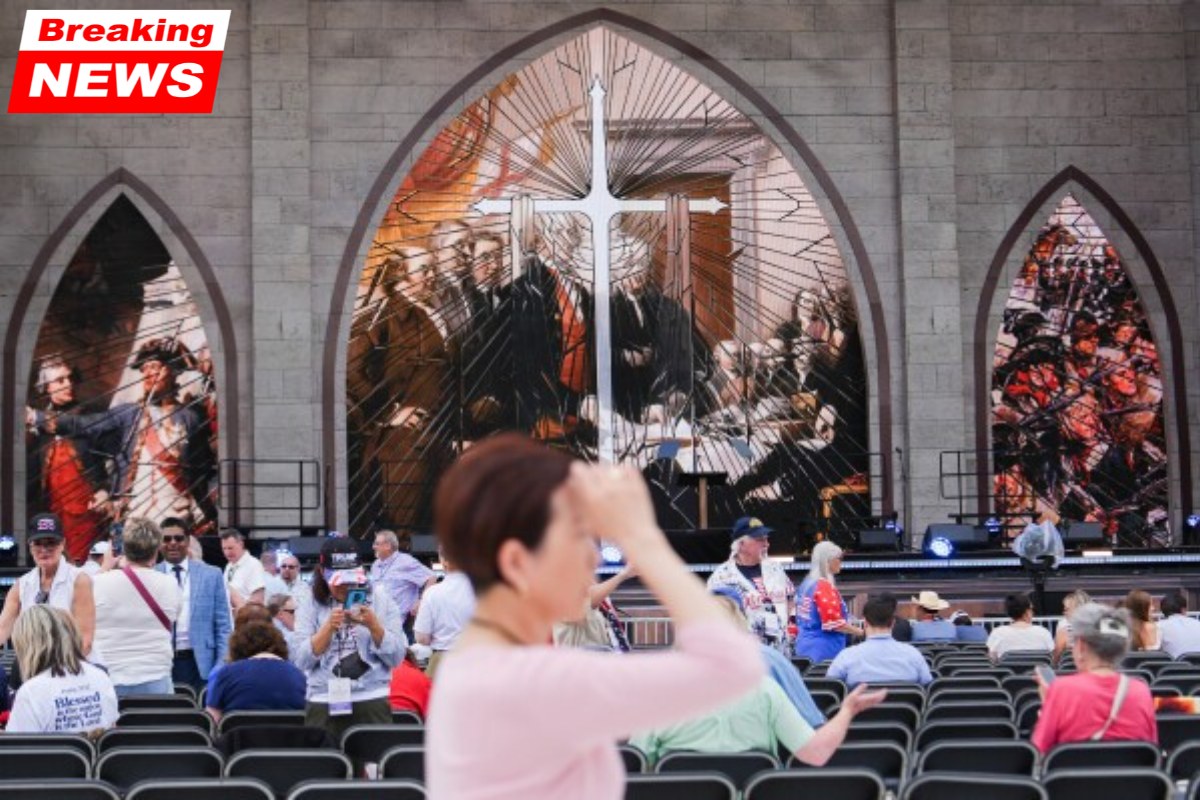
Thousands of people gathered on the National Mall in Washington, D.C., for the Rededicate 250 prayer rally, a daylong event described as a “rededication of our country as One Nation under God.” The rally took place under the iconic Washington Monument, featuring worship music, Christian imagery, and speeches connecting faith with American history .
Arched stained-glass windows behind the stage depicted the nation’s founders alongside a white cross, reinforcing the Christian focus of the gathering. Organizers described the event as part of the United States’ 250th-anniversary celebrations, emphasizing a return to religious values as a foundation for the nation.
Political and Religious Figures at the Rally
The event featured a lineup dominated by conservative Christian leaders and political figures:
| Speaker/Participant | Role/Background | Notable Contributions |
|---|---|---|
| Donald Trump | Former President | Read 2 Chronicles passage via video; echoed themes of Christian nationalism |
| JD Vance | Vice President | Participated in speeches; emphasized Christian values |
| Pete Hegseth | Secretary of Defense | Led prayers to Jesus; linked faith with national service |
| Marco Rubio | Secretary of State | Highlighted Christian principles in governance |
| Mike Johnson | House Speaker, R-La. | Participated in conservative Christian messaging |
| Paula White-Cain | Evangelist | White House Faith Office; long-time Trump supporter |
| Franklin Graham | Evangelist | Samaritan’s Purse leader; advocate of Christian nationalism |
| Meir Soloveichik | Orthodox Rabbi | Only non-Christian speaker; condemned antisemitism |
| Cardinal Timothy Dolan & Bishop Robert Barron | Catholic Clerics | Featured speakers promoting religious liberty |
This lineup emphasized Christianity’s historical connection to the United States, a view that critics say supports a narrow interpretation of American identity. Rabbi Meir Soloveichik stood out as the sole non-Christian religious leader, highlighting the importance of interfaith inclusion while affirming opposition to antisemitism .
Christian Nationalism and Criticism
The rally drew attention for its ties to Christian nationalism, a belief that the U.S. was founded as a Christian nation. Critics argue this perspective oversimplifies American history and marginalizes other faiths.
The Rev. Adam Russell Taylor of Sojourners warned, “We are deeply concerned that what is really being rededicated is a nation to a very narrow and ideological part of the Christian faith that betrays our nation’s fundamental commitment to religious freedom” .
Rabbi Jonah Dov Pesner emphasized the historical religious diversity of early America, noting the presence of Jews, Muslims, and Indigenous faiths. “I want to shine a light on America’s history as a nation that welcomes, celebrates, and protects people of all faiths and those of no faith,” Pesner said.
Attendee Perspectives
Many attendees viewed the rally as an essential spiritual and patriotic event. Denny Smith, 72, traveled from Rhode Island on a motorized scooter, saying, “It’s all about Jesus” . Retha Bond, 58, a Trump supporter from southern Illinois, described the event as “one of the most important things that could be going on in the world, for us to rededicate our nation back to God.”
Younger attendees like 15-year-old Alessandra Seawright echoed the sentiment, citing late activist Charlie Kirk as an inspiration and expressing a desire for more events that combine faith and civic engagement.
Counterprogramming and Public Response
Progressive organizations staged protests in response to Rededicate 250. The Freedom From Religion Foundation and Faithful America displayed a balloon resembling a golden calf, referencing biblical idolatry, to critique the merging of politics and religion .
The Interfaith Alliance projected slogans onto the National Gallery of Art emphasizing church-state separation, including “Democracy not theocracy” and “The separation of church and state is good for both.” These actions reflected broader concerns about the role of religious ideology in American governance.
Organizational and Political Context
Rededicate 250 was organized by Freedom 250, a public-private partnership supported by the White House. Congressional Democrats have questioned the nonprofit’s structure and finances, suggesting it operates as a Trump-controlled alternative to a previous commission established to organize semiquincentennial events .
The Rededicate 250 prayer rally highlighted the intersection of faith, politics, and American identity. While supporters see it as a patriotic and spiritual renewal, critics caution that it risks promoting a narrow interpretation of Christianity over the country’s diverse religious heritage.
The event underscores ongoing debates about religious freedom, political influence, and the historical foundations of the United States.