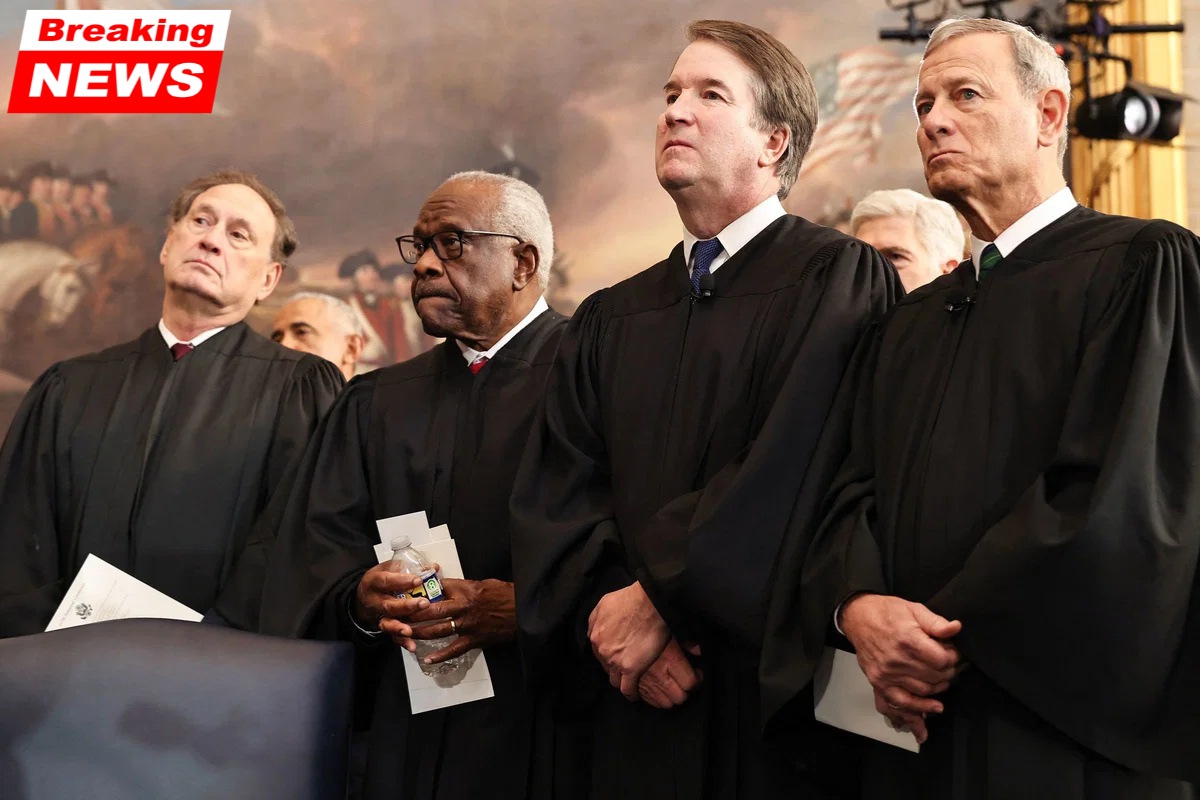
As the Supreme Court heads toward the final weeks of its term, the issue of judicial precedent has been at the forefront of debates surrounding its decisions. Chief Justice John Roberts has made efforts to defend his colleagues, asserting that the Roberts court has not overruled precedent as often as critics might suggest.
However, in recent rulings, the Court has increasingly veered from long-standing precedents without explicitly overturning them. This has raised concerns about the Court’s approach to legal stability and the impact of these decisions on the public’s trust in the judicial system.
Chief Justice Roberts Defends the Court’s Approach to Precedent
In a rare public appearance, Chief Justice Roberts defended the Court’s handling of precedents. Speaking at Georgetown University Law Center, Roberts pointed to statistics showing that the current Court has overruled fewer precedents compared to its predecessors, averaging less than two overrulings per year. He emphasized that the Roberts Court had been cautious and deliberate in its decisions regarding precedent.
However, just days after his statement, the Court’s decision to allow President Donald Trump’s dismissal of two senior labor officials—despite a 1935 precedent known as Humphrey’s Executor—raised questions about the Court’s consistency in adhering to established legal principles.
Critics argued that, while the Court didn’t explicitly overturn Humphrey’s Executor, its decision effectively gutted the precedent, indicating a shift in its approach to longstanding rulings.
The Case of the Voting Rights Act
In addition to the Humphrey’s Executor case, another major ruling in 2023 involved the Voting Rights Act of 1965. The Court’s decision to invalidate a Louisiana congressional map and weaken key provisions of the Voting Rights Act drew criticism for undermining decades of precedent.
Justice Elena Kagan, writing in dissent, noted that the Court’s ruling overturned Congress’s determined approach to addressing racial inequalities in elections, despite previous decisions that upheld the law’s effectiveness.
The case illustrated a growing pattern in which the Court, particularly under Roberts, is increasingly willing to reinterpret or effectively neutralize legal precedents without formally overturning them.
Legal experts, like Steve Vladeck, argue that this approach—what some have referred to as “stealth overrulings”—makes it difficult for legal practitioners, Congress, and the public to understand the true scope of the Court’s decisions.
“Stealth Overrulings”: The New Trend
The trend of “stealth overrulings,” as described by law professors like Richard Pildes of New York University, refers to instances where the Court undermines a precedent without explicitly declaring it overturned. While the Court may not formally announce the overruling of past decisions, it often reinterprets key aspects of those decisions in ways that strip them of their practical significance.
For instance, in the case involving the Voting Rights Act, the majority ruling redefined how racial discrimination claims should be evaluated in redistricting. This marked a stark departure from the Court’s previous stance, but the majority opinion, written by Justice Samuel Alito, insisted that the precedent was not being overruled.
Critics argue that this undermines the spirit of the Voting Rights Act, which has long been understood to allow claims based on discriminatory effects rather than requiring proof of discriminatory intent.
Examples of Clear and Subtle Overturning of Precedents
The Roberts Court has had its share of explicit overrules, such as the overturning of Roe v. Wade in 2022 and the 1984 Chevron decision. In both cases, the Court explicitly stated that previous rulings were being reversed.
For example, in Roe v. Wade, Justice Alito wrote that the decision was “egregiously wrong from the start.” Similarly, in the 2023 Chevron ruling, Roberts clearly stated that the decision was overruled.
However, these cases are the exception rather than the rule. Most of the Court’s recent decisions, such as those involving the Voting Rights Act or Humphrey’s Executor, involve reworking established precedents in ways that are less clear-cut but still have significant legal consequences.
The Difficulty in Identifying “Stealth Overrulings”
As noted by law professor Lee Epstein, overturning precedents explicitly occurs in only a small percentage of cases, but departures from precedent are more common. In a study of 558 cases, Epstein found that explicit overrulings occurred in just 4% of cases where prior decisions were targeted, while a broader 28% of cases involved deviations from precedent.
This subtle shift in judicial reasoning raises concerns about the stability of the law and the Court’s role in upholding consistent legal principles. When precedents are overturned without clear acknowledgment, it becomes more difficult for citizens, lawmakers, and legal professionals to navigate the evolving legal landscape.
The Case of Humphrey’s Executor and Future Implications
Looking ahead, the Court is poised to revisit several precedents, including Humphrey’s Executor, which protects the leaders of independent agencies from dismissal by a president without cause. While the Court has not explicitly overturned this precedent, its earlier rulings have already severely limited its application.
In oral arguments regarding the Trump administration’s efforts to remove agency leaders, Solicitor General D. John Sauer pointed out that the Court had already undermined Humphrey’s in previous cases, suggesting that the precedent might be on life support.
This raises an important question: When does a precedent cease to function in practical terms, even if it hasn’t been explicitly overturned? The Court’s current approach suggests that the line between formally overturning a precedent and simply hollowing it out may be blurrier than ever.
Summary Table: Key Developments in Precedent and the Roberts Court
| Case/Precedent | Impact of the Court’s Ruling |
|---|---|
| Roe v. Wade (2022) | Explicitly overturned, ending the constitutional right to abortion. |
| Chevron (2023) | Overruled the 1984 decision empowering federal agencies to interpret vague laws. |
| Humphrey’s Executor (1935) | Severely limited, as the Court continues to chip away at its protections. |
| Voting Rights Act (2023) | Redefined how racial discrimination in redistricting is evaluated. |
| Louisiana v. Callais (2024) | Neutered the precedent without formally overruling it, impacting Voting Rights Act interpretations. |
The Roberts Court’s Legacy on Precedent
The Roberts Court’s handling of precedent continues to generate significant debate. While Chief Justice Roberts maintains that the Court is cautious about overturning established rulings, many critics argue that the Court has been increasingly willing to rework precedents in ways that undermine their original intent.
Whether through explicit reversals or more subtle shifts, the Court is charting a new course for legal stability that may have far-reaching implications for future rulings.
The challenge for legal observers, Congress, and the public will be to navigate a legal system where the impact of Supreme Court decisions is not always immediately clear, and where precedents may be “overruled” without the formal acknowledgment that once marked the Court’s most significant decisions.