
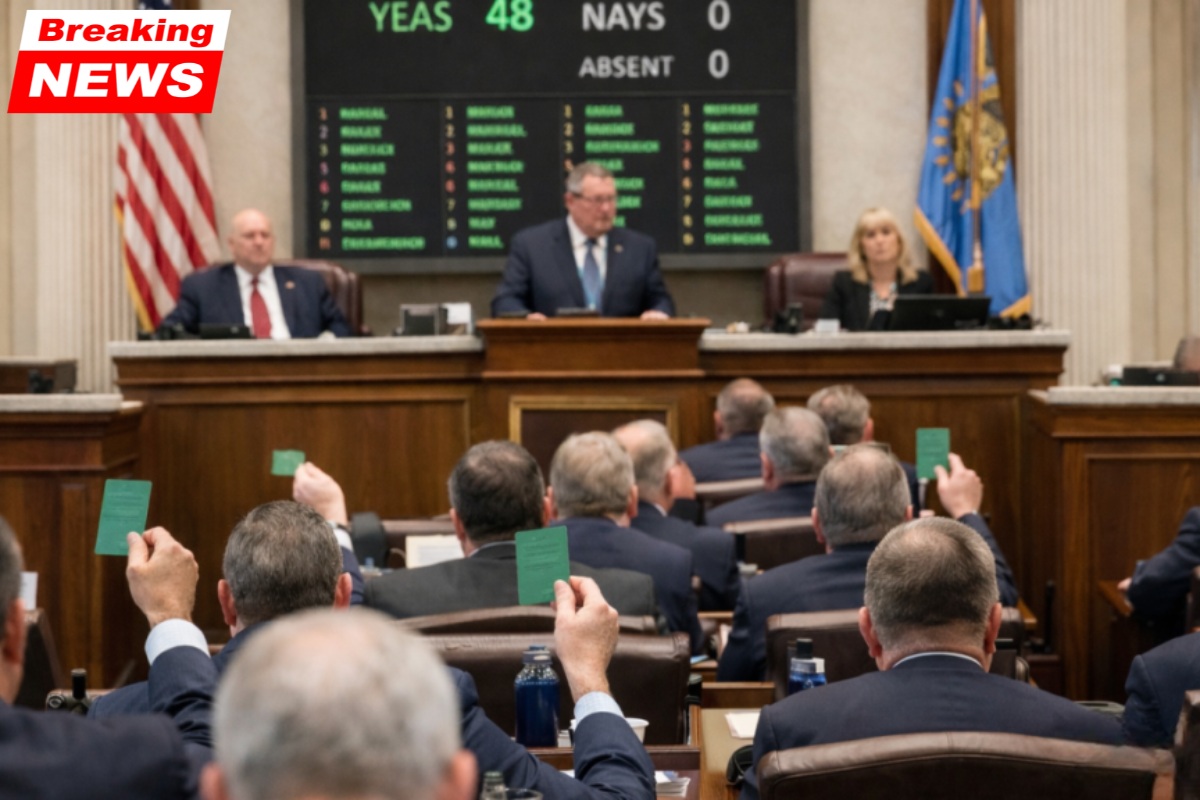
Oklahoma is on track to become the latest state to ban sweepstakes casinos, and the legislative momentum makes the outcome increasingly clear. Senate Bill 1589 has advanced with unanimous support at every stage so far. It passed the Senate 48-0 in March, cleared a House committee 6-0 on April 7, and now awaits one final committee step before heading to a full House vote.
With the legislative session running through May 29, the timeline leaves plenty of room for final approval. Given the consistent bipartisan backing, the real question is no longer if the ban will pass, but when it will officially become law.
What SB 1589 Actually Does
SB 1589, introduced by Todd Gollihare and Scott Fetgatter, focuses on redefining how gambling is interpreted under state law. While the language is technical, the impact is direct and targeted.
The bill expands the definition of “something of value” in gambling. This change is designed to address the dual-currency system used by sweepstakes casinos.
These platforms typically operate with two types of virtual currency:
- Gold Coins, which can be purchased but have no cash value
- Sweeps Coins, which cannot be purchased directly but can be redeemed for real money
Operators have long argued that this structure avoids traditional gambling definitions. SB 1589 removes that argument by stating that any virtual currency tied to redeemable rewards qualifies as something of value.
The bill also classifies the promotion or operation of online casino-style games as a Class C2 felony if they involve value-based systems. This includes games that replicate slot machines, bingo, or lottery-style formats. Penalties range from $500 to $2,000 in fines.
Importantly, enforcement extends beyond operators. Marketers, affiliates, and service providers could also face penalties, closing loopholes seen in other states.
An exception is included for tribal gaming operations. Under the Indian Gaming Regulatory Act, tribal operators can continue offering social casino-style experiences on tribal lands. This aligns with Oklahoma’s existing gambling framework rather than expanding it.
A Growing Nationwide Crackdown
Oklahoma’s move is part of a broader national trend. Since 2025, multiple states have taken action against sweepstakes casinos, signaling a shift in how regulators view the industry.
Recent developments include:
- Indiana banning sweepstakes casinos through HB 1052, signed by Mike Braun
- Maine passing LD 2007 under Janet Mills
- California implementing a ban effective January 1, 2026
Additional states with existing bans include Connecticut, New Jersey, New York, Montana, and Washington. Meanwhile, states like Maryland, Louisiana, Minnesota, and Tennessee are actively considering similar legislation.
The common thread is a growing agreement among lawmakers that the dual-currency system is not a legitimate distinction, but a workaround. As a result, regulation is rapidly shifting toward outright bans.
What Happens If the Bill Passes
If SB 1589 completes the legislative process and is signed by Kevin Stitt, it will take effect on November 1, 2026.
This delayed enforcement gives operators time to exit the state or shut down services. Compared to states like Indiana and Maine, which implemented faster timelines, Oklahoma provides a longer transition period.
For players, this means sweepstakes platforms will remain accessible for a limited time. However, the unanimous votes seen so far suggest the bill’s passage is highly likely.
For residents who rely on these platforms as an alternative to traditional gambling, the change will be significant. Oklahoma currently limits legal gambling to:
- State lottery
- Horse racing
- Tribal gaming
This ban does not introduce a new regulated online alternative, leaving fewer options for players.
Impact on the Sweepstakes Casino Industry
The sweepstakes casino industry is entering a much stricter regulatory phase. Just a short time ago, these platforms operated in most states. Now, that footprint is shrinking quickly.
The core legal argument behind the industry is being rejected across the country. States are increasingly treating virtual currencies that convert to cash as equivalent to gambling.
Operators now face three main choices:
- Exit states before enforcement begins
- Continue operating and risk legal consequences
- Push for regulation instead of prohibition
Some states have explored tying bans to broader online gambling legalization, which would allow licensed operators to replace sweepstakes platforms. However, Oklahoma has not paired SB 1589 with any such proposal.
This leaves the bill as a straightforward ban with no immediate alternative.
Key Details Summary
| Category | Information |
|---|---|
| Bill Name | Senate Bill 1589 |
| State | Oklahoma |
| Senate Vote | 48-0 |
| House Committee Vote | 6-0 |
| Key Sponsors | Todd Gollihare, Scott Fetgatter |
| Target | Sweepstakes casinos using dual-currency systems |
| Penalty | Class C2 felony, $500–$2,000 fine |
| Exception | Tribal gaming under federal law |
| Expected Effective Date | November 1, 2026 |
Oklahoma’s SB 1589 represents a decisive move against sweepstakes casinos. With unanimous support at every stage so far, the bill is on a clear path toward becoming law.
This is not an isolated development. It reflects a nationwide shift in how lawmakers view the industry. The legal gray area that once allowed sweepstakes casinos to grow is closing rapidly.
For operators, the environment is becoming increasingly restrictive. For players, access is shrinking. And for regulators, the focus is now on clarity and enforcement rather than interpretation.
If current momentum holds, Oklahoma will soon join the growing list of states that have chosen to eliminate sweepstakes casinos entirely.






