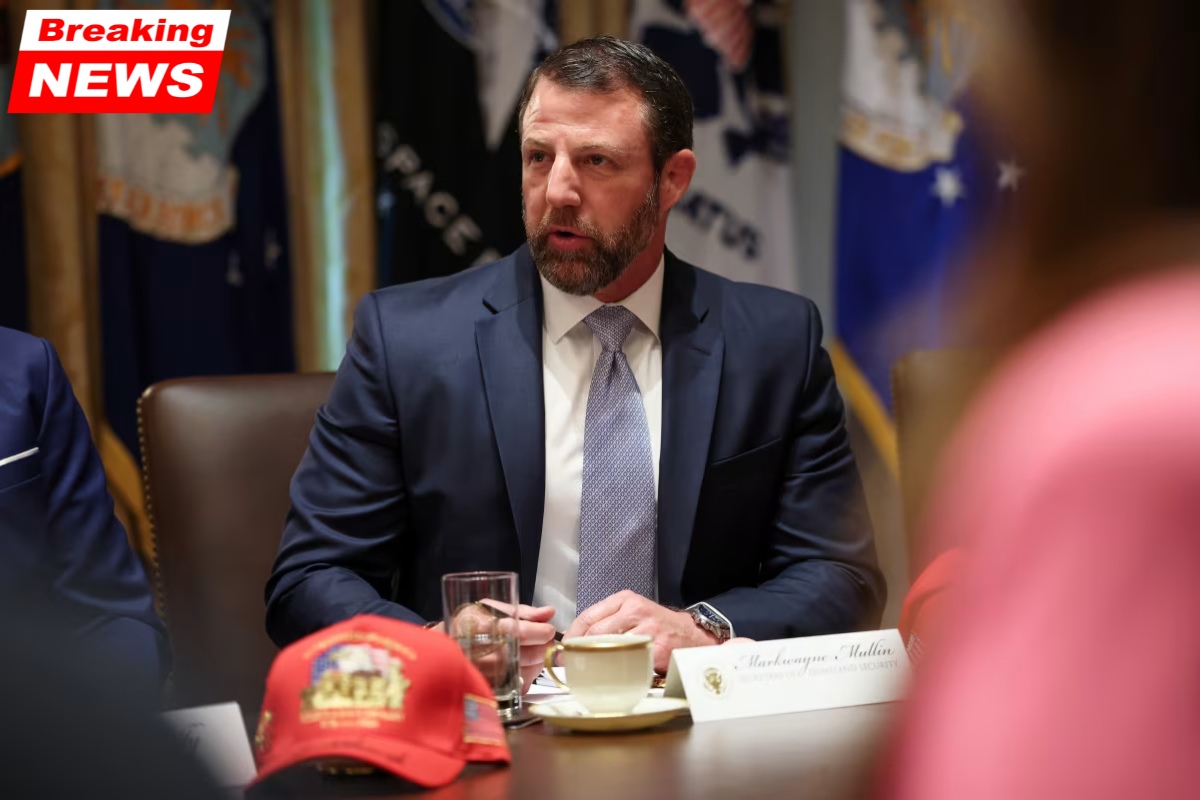
Department of Homeland Security Secretary Markwayne Mullin has become focused on a plan to punish cities and states that do not cooperate with federal immigration enforcement.
His idea involves cutting Customs and Border Protection staffing at airports in those jurisdictions and potentially halting the processing of international travelers altogether.
The ambitious proposal has already sent shockwaves through the travel industry and local governments, who warn of the plan’s disruptive potential.
The plan has also faced public opposition from fellow Cabinet members and has not been formally approved by the White House.
Mullin’s Rationale for the Proposal
Mullin argued that “radical left Democrats” who refuse to allow federal immigration enforcement in their communities should not benefit from the processing of international flights at their facilities.
Speaking to Fox News, he said: “They don’t want us to enforce immigration but they want us to process immigration at their facilities? Nothing about that makes sense to me.”
This plan reflects Mullin’s desire to pressure sanctuary jurisdictions into cooperating with federal immigration laws, presenting airport staffing as leverage to enforce compliance.
Industry and Government Reactions
Airlines have not publicly commented on the feasibility or timing of the proposal, but the travel industry has expressed concern about the potential consequences.
Reducing Customs staffing at major airports could significantly disrupt airline operations, tourism, and the flow of international cargo.
Transportation Secretary Sean Duffy criticized Mullin’s plan during a congressional hearing, saying, “We shouldn’t shut down air travel in a state that doesn’t agree with our politics.” Airlines for America, representing major U.S. carriers, warned that the move “would have a devastating effect on the airline and tourism industries, causing significant operational disruption to carriers, travelers and the flow of international cargo.”
The U.S. Travel Association confirmed it recently met with Mullin, who reiterated his previous statements about possibly withdrawing customs personnel from major international airports.
The association warned that such a move would have “devastating consequences for the travel industry and communities that depend on international visitation.”
Status and Internal Politics
Two Trump administration officials told CNN that Mullin’s airport plan is largely his personal initiative and is not a White House-driven policy.
Since being sworn in as DHS secretary in March, replacing Kristi Noem, Mullin has repeatedly raised the idea in meetings, sometimes unprompted.
A White House official commented, “The President loves having a team that is constantly coming up with new ideas but ultimately any policy decisions will be up to him.”
While Mullin has been seen as stabilizing DHS after a chaotic year under Noem, this proposal could have far-reaching consequences if enacted.
Potential Impacts on Travel and Trade
If implemented, the plan could disrupt international travel across both red and blue states. Airline routes are scheduled far in advance, and rerouting flights to avoid sanctuary jurisdictions would be complex, particularly at high-capacity airports.
Major U.S. airports potentially affected include JFK in New York, SFO in San Francisco, and Dulles International and Ronald Reagan Washington National Airport in Virginia.
These airports serve as key hubs for both passengers and cargo, meaning any reductions in Customs staffing could create cascading disruptions nationwide.
Sanctuary Jurisdictions Targeted
Sanctuary cities typically limit local cooperation with federal immigration enforcement. The Department of Justice maintains a list of jurisdictions it considers sanctuary areas, which has expanded this year.
Mullin has criticized Virginia Governor Abigail Spanberger, who signed an executive order restricting cooperation with federal immigration officers. Dulles and Reagan National Airports, both serving the Washington, DC area, are located in Virginia.
Other jurisdictions on the DOJ list include New York City, Los Angeles, Seattle, and Philadelphia. Pennsylvania Governor Josh Shapiro has publicly stated that his state “will respond” if the federal government acts in a “reckless, chaotic, cruel way.”
Summary Table of Key Facts
| Aspect | Details |
|---|---|
| DHS Secretary | Markwayne Mullin |
| Proposal | Reduce Customs staffing at airports in sanctuary jurisdictions; potentially halt international processing |
| Target Jurisdictions | New York City, Los Angeles, Seattle, Philadelphia, parts of Virginia |
| Opposition | Transportation Secretary Sean Duffy, airline trade associations, state officials |
| Potential Impacts | Travel disruptions, trade and tourism disruptions, logistical challenges rerouting flights |
| Status | No imminent implementation; considered Mullin’s personal initiative |
| Key Airports Affected | JFK (NY), SFO (CA), Dulles and Reagan National (VA) |
| Definition of Sanctuary | Jurisdictions limiting cooperation with federal immigration enforcement |
| Political Context | Criticism of Governors Spanberger (VA) and Shapiro (PA) |
Secretary Mullin’s proposed plan to punish sanctuary jurisdictions by cutting Customs staffing at airports has generated significant concern from industry leaders, state officials, and fellow Cabinet members.
While framed as a tool to enforce federal immigration laws, the proposal could disrupt international travel, trade, and tourism nationwide.
Currently, the plan remains largely a personal initiative of Mullin, with no formal White House approval. If implemented, the proposal highlights growing tensions between federal immigration enforcement priorities and local autonomy in sanctuary jurisdictions.