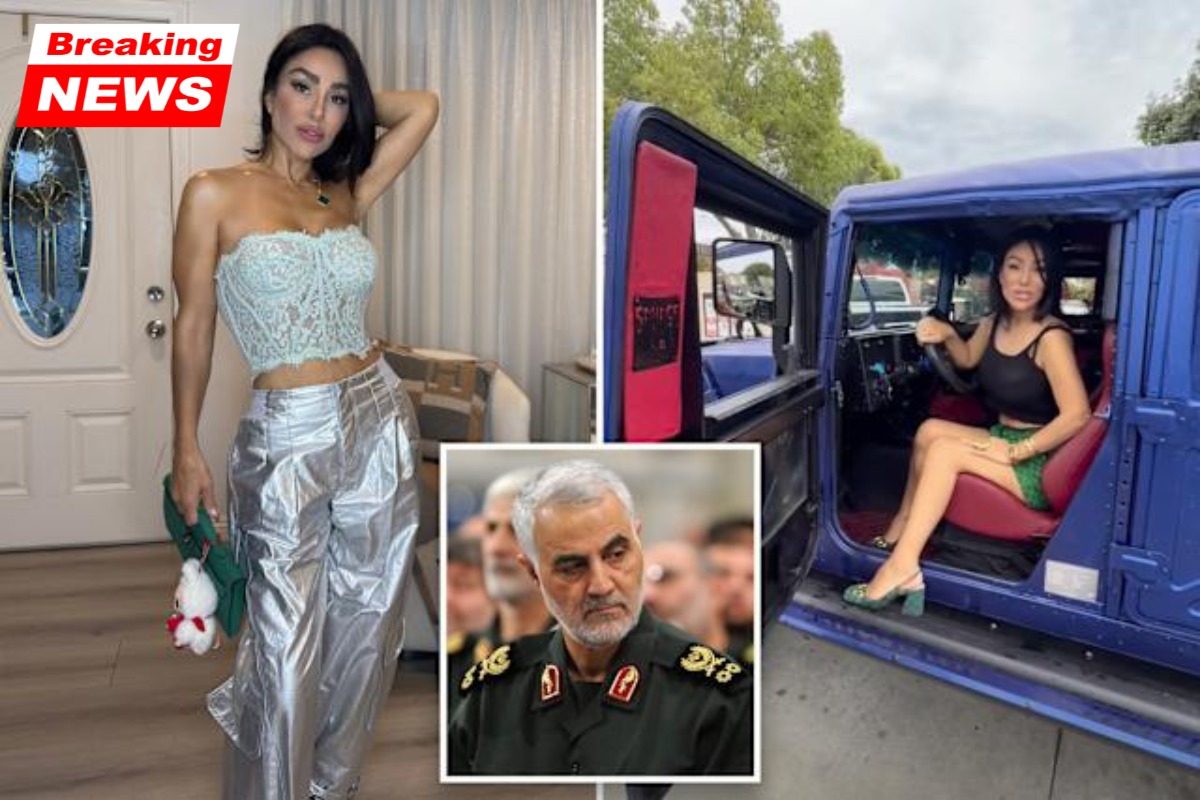
Immigration and Customs Enforcement (ICE) agents have arrested Hamideh Soleimani Afshar, the niece of the late Iranian General Qasem Soleimani, and her daughter Sarinasadat Hosseiny, 25, after both had their green cards revoked. The arrests, confirmed by the State Department on Friday, were the result of their alleged involvement in promoting Iranian regime propaganda and denouncing the United States.
Details of the Arrests and Alleged Activities
According to the NY Post, the State Department’s letter stated that Afshar, 47, had been actively supporting Iranian propaganda, including celebrating attacks against American soldiers and military facilities in the Middle East. She was also accused of praising Iran’s Supreme Leader and voicing her support for the Iranian Revolutionary Guard Corps (IRGC), which is recognized as a terrorist organization by the U.S. government.
Afshar’s connection to General Qasem Soleimani, the head of the Quds Force, who was killed in a U.S. drone strike in Iraq in 2020, adds further complexity to the case. Social media posts from Afshar, which have since been deleted, reportedly displayed her extravagant lifestyle, including luxury designer handbags, a Tesla Model 3, expensive cars, and outfits that would violate the strict dress codes of the Islamic Republic she was allegedly supporting.
Her daughter, Sarinasadat Hosseiny, also had her social media accounts removed after they allegedly showcased a stark contrast to the ideology Afshar was promoting. Hosseiny’s posts reportedly featured images of her in bikinis, sporting tattoos, enjoying jet skis, and partying in places like Miami, Alaska, and Las Vegas. These posts, as noted by authorities, clashed with the conservative Shia Islam her mother was said to advocate for online.
Political Reactions and Diplomatic Tensions
Secretary of State Marco Rubio praised the revocation of the green cards, asserting that the Trump Administration would not allow foreign nationals who support anti-American regimes to live in the U.S. Lauren Bis, a spokesperson for the Department of Homeland Security (DHS), echoed this sentiment, emphasizing that green cards are privileges and can be revoked if there are concerns about an individual posing a threat to national security.
The arrests have come at a time when U.S.-Iran tensions are escalating, with both countries exchanging increasingly aggressive rhetoric. Afshar, who entered the U.S. in 2015 on a tourist visa, was granted asylum in 2019 and obtained her green card in 2021 under the Biden administration.
Hosseiny entered the U.S. on a student visa in 2015 and received her green card in 2023. The DHS also revealed that Afshar made at least four trips back to Iran after obtaining her green card, a detail that raises further questions about her activities and affiliations.
Details from Neighbors and Previous Similar Cases
According to neighbors in the Tujunga area of Los Angeles, where Afshar was residing in a backyard unit, the arrests were dramatic. Halasius Bradford, who rents the main house on the property, reported that Hosseiny’s boyfriend informed him that ICE agents had cut them off while they were driving, demanding to know where Afshar was.
This case follows similar actions by the U.S. government. Last month, the State Department revoked the legal status of Fatemeh Ardeshir-Larjiani, the daughter of former Iranian national security official Ali Larjiani, after a joint U.S.-Israeli airstrike killed her father on March 16.
Iran’s Response to the Arrests
Despite the U.S. government’s claims, Soleimani’s daughter, in a post on social media, denied any relation between the arrested individuals and General Qasem Soleimani. She accused the U.S. of lying, stating, “The individuals arrested in the United States have no relation whatsoever to the family of Martyr Soleimani.” This denial adds a layer of complexity to the case, especially as the Iranian regime continues to deny any connection between the individuals and its key figures.
Ongoing Diplomatic and Military Tensions
The arrests come amid ongoing tensions between the U.S. and Iran, particularly concerning the continued military operations and rhetoric in the region. Iran has also unveiled a new model of ballistic missiles, named “Haj Qassem” in honor of General Soleimani, designed to evade Israel’s Iron Dome defense system.
This development, alongside the arrests of individuals connected to the regime, highlights the ongoing geopolitical friction and the complexities surrounding the U.S.-Iran relationship.
Summary Table
| Key Event | Details |
|---|---|
| Arrests of Afshar and Hosseiny | ICE arrests the niece of General Soleimani and her daughter for alleged support of Iranian propaganda |
| Revocation of Green Cards | Both women had their green cards revoked due to national security concerns |
| Afshar’s Social Media Activity | Afshar allegedly celebrated attacks on U.S. soldiers and praised the IRGC |
| Hosseiny’s Contradictory Lifestyle | Hosseiny’s social media reportedly showed a lifestyle in contrast to her mother’s conservative ideology |
| U.S. Political Reaction | Marco Rubio and DHS spokesperson praised the revocation of their green cards |
| Iran’s Response | Soleimani’s daughter denied any connection to the arrested individuals |
| Ongoing U.S.-Iran Tensions | The arrests occur amidst rising tensions and military developments, including new Iranian missile technology |
The arrest of Hamideh Soleimani Afshar and her daughter Sarinasadat Hosseiny adds a new chapter to the escalating tensions between the U.S. and Iran. The case highlights the U.S. government’s ongoing efforts to crack down on individuals supporting the Iranian regime, especially in the context of national security concerns.
With diplomatic backchannels remaining complex and contested, this incident underscores the continued volatility in U.S.-Iran relations, particularly as both nations prepare for what could be a prolonged and unpredictable standoff.