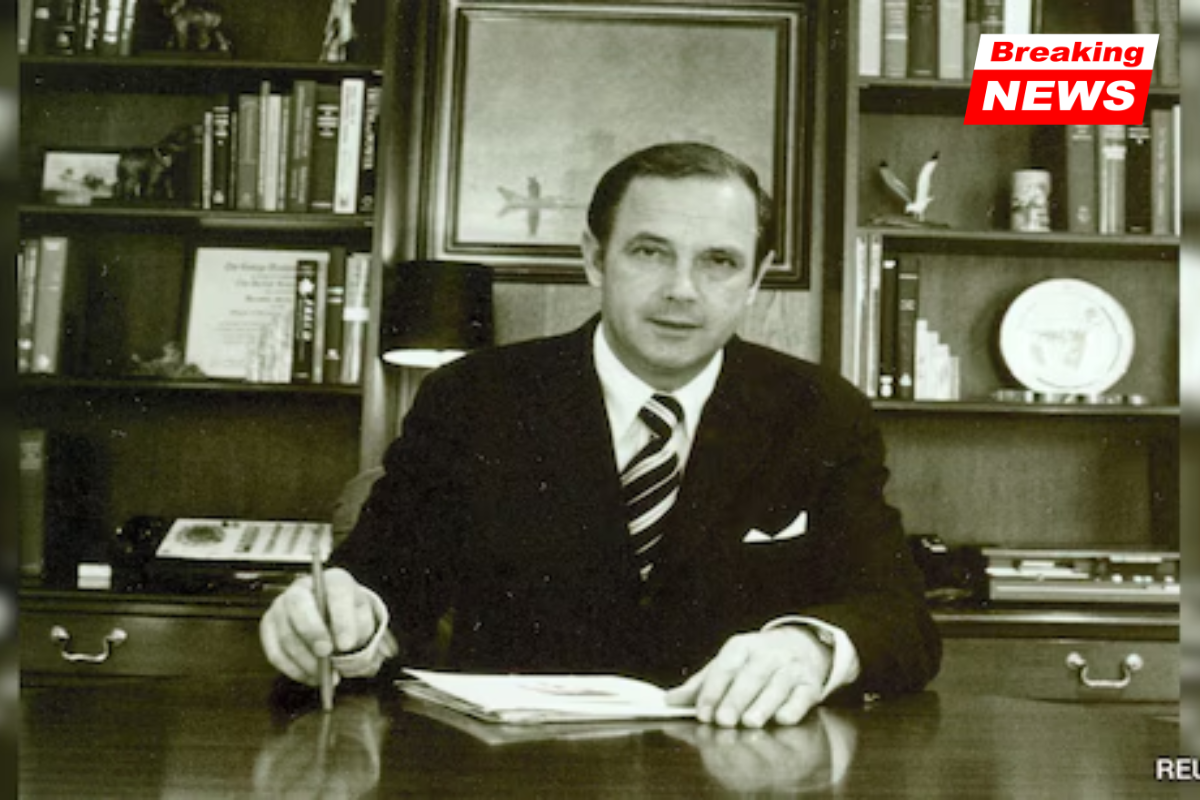
Alexander Butterfield, the former White House aide whose testimony revealed the existence of President Richard Nixon’s secret recording system during the Watergate investigation, has died at the age of 99. His unexpected disclosure about the taping system became one of the most important moments in the Watergate scandal and played a major role in events that eventually led to Nixon’s resignation.
Alexander Butterfield Dies at 99
Alexander Butterfield’s death was confirmed by his wife, Kim Butterfield, and former White House counsel John Dean.
Dean, who also played a key role in exposing the Watergate cover-up, said Butterfield carried a heavy responsibility when he revealed the existence of Nixon’s secret recording system.
Butterfield had been sworn to secrecy about the system, but during congressional testimony he told investigators the truth about how conversations in the White House were being recorded.
His disclosure became a turning point in the Watergate investigation.
Role in Revealing Nixon’s Secret Taping System
Butterfield served as a deputy assistant to President Richard Nixon from 1969 to 1973.
In that role, he oversaw the secret recording system installed in several locations connected to the president.
The voice-activated system recorded conversations in places such as:
- The Oval Office
- The Cabinet Room
- Nixon’s office in the Executive Office Building
- The presidential retreat at Camp David
Butterfield later explained that nearly every conversation involving the president was recorded automatically whenever Nixon was present.
Only a small group of people were believed to know about the system, including Nixon himself, White House Chief of Staff H.R. Haldeman, and a few Secret Service agents.
Testimony That Changed the Watergate Investigation
The existence of the taping system became public during the Senate investigation into the Watergate break-in.
On July 13, 1973, investigators privately questioned Butterfield during their inquiry.
A staff member asked him whether any recording devices existed in the White House. The question was prompted by testimony from former White House counsel John Dean, who suspected that one of his conversations with Nixon had been recorded.
Butterfield confirmed that the taping system existed.
Three days later, on July 16, 1973, he publicly revealed the information during a Senate committee hearing.
The revelation shocked both Nixon’s supporters and critics because the recordings could provide direct evidence about what the president knew regarding the Watergate scandal.
Tapes Exposed the Watergate Cover-Up
The Watergate scandal began with a break-in at the Democratic National Committee headquarters at the Watergate complex in 1972.
Investigators believed members of Nixon’s campaign were involved in the burglary and the effort to cover it up.
Butterfield’s testimony revealed that recorded conversations might show Nixon’s involvement.
A long legal battle followed as investigators demanded access to the tapes.
In July 1974, the U.S. Supreme Court unanimously ordered Nixon to release them to prosecutors.
The recordings exposed details of the cover-up and showed Nixon’s role in obstructing the investigation.
Facing likely impeachment by Congress, Nixon resigned from the presidency on August 9, 1974.
He became the first U.S. president in history to step down from office.
Butterfield Reflected on His Role
Butterfield later acknowledged that revealing the tapes may have influenced the outcome of Nixon’s presidency.
In a 2008 oral history interview with the Nixon Presidential Library, he said he realized the recordings contained extremely damaging information.
He described them as “dynamite” because they captured Nixon’s private conversations in unfiltered detail.
However, Butterfield said he never expected the situation to end with a president resigning.
At the time, no U.S. president had ever been forced from office.
Career After the White House
Before joining the Nixon administration, Butterfield had a long career in the military.
He served in the U.S. Air Force for 20 years and retired with the rank of colonel.
During his military service, he worked in several roles including:
- Instructor during the Korean War
- Military assignments in Germany
- Pentagon positions assisting defense leadership
After leaving the White House in 1973, Butterfield became administrator of the Federal Aviation Administration.
He later believed he was removed from that position in 1975 because of tensions connected to his Watergate testimony.
Following his government service, Butterfield worked as a business executive in California.
He also earned a master’s degree from the University of California, San Diego, in 1994.
Early Life and Education
Alexander Porter Butterfield was born on April 6, 1926, in Pensacola, Florida.
He attended the University of California, Los Angeles before joining the military.
Later, he completed a bachelor’s degree at the University of Maryland in 1956.
He also earned a master’s degree from George Washington University in 1967.
Later Views on Richard Nixon
In later interviews, Butterfield was openly critical of his former boss.
While he acknowledged Nixon’s accomplishments in foreign policy, he said he believed the president was dishonest and responsible for the Watergate cover-up.
Butterfield even said he believed Nixon had knowledge of the Watergate burglary before it occurred.
When Nixon resigned in 1974, Butterfield said he felt relief.
He later recalled feeling that justice had finally prevailed after a long and difficult investigation.