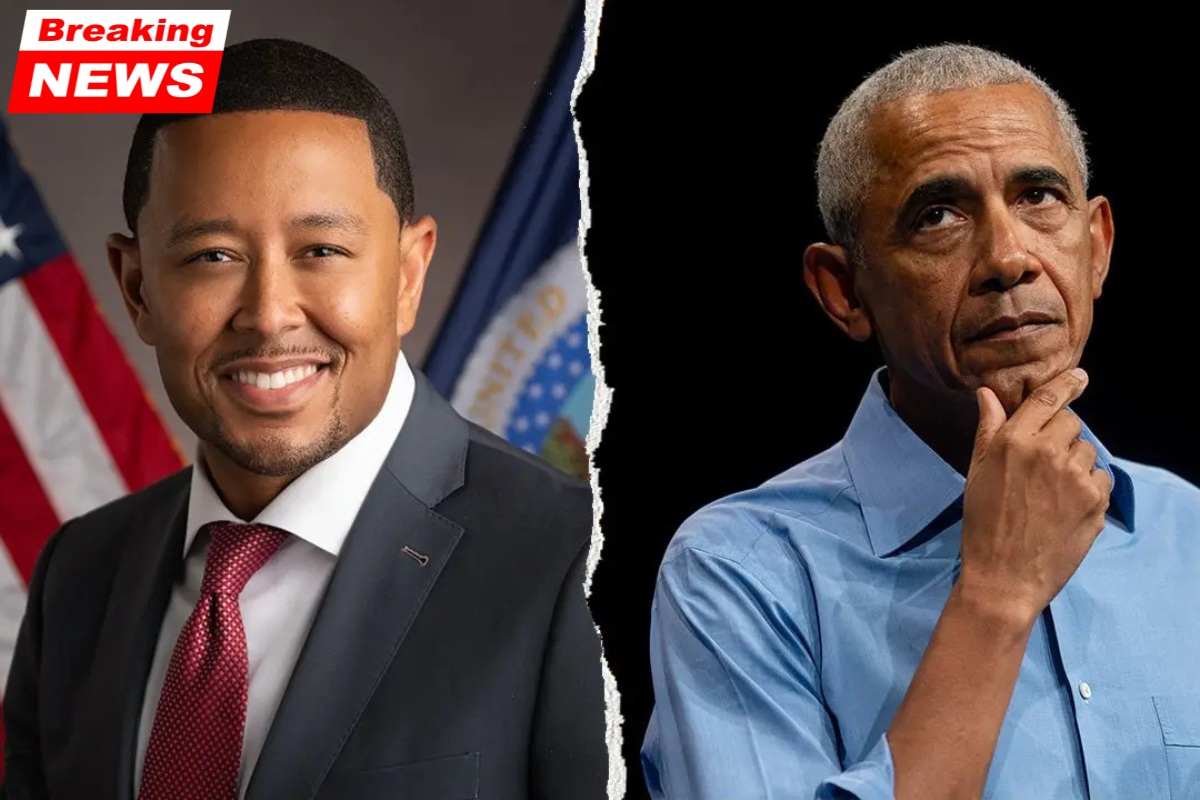
Tahrohon Wayne (T.W.) Shannon, Oklahoma’s first African American speaker of the House, has come out strongly against former President Barack Obama’s criticism of a recent Supreme Court ruling that reshaped the landmark 1965 Voting Rights Act.
The court’s 6-3 decision on Wednesday struck down Louisiana’s 6th Congressional District, which was redrawn in 2024 to have a predominantly Black electorate, and declared that states cannot use race to draw districts in ways that either disenfranchise voters or support minority communities’ preferred candidates.
While Obama condemned the ruling as a setback for minority voters and called it an example of the Court abandoning principles of equal participation, Shannon disagrees.
Shannon, who is currently running for lieutenant governor of Oklahoma, believes the decision further removes race from American politics and empowers people to succeed without special treatment based on race.
Shannon’s Response to Obama’s Criticism
Shannon, fiercely opposing Obama’s view, argued that the ruling is not a blow to minority rights but instead an affirmation that race should not play a role in redistricting decisions. He called Obama’s framing of the decision “nonsense” and claimed it perpetuates racial division in America.
“The idea that you must have a racially drawn district in order to win and compete is just nonsense,” Shannon said. He emphasized that the ruling aligns with the principle that racial considerations should not dictate political boundaries, and that success in politics should not be tied to race-based districts.
Shannon’s comments reflect his broader perspective on racial politics, rejecting the notion that America’s systems are inherently racist. He said, “The entire country is just kind of tired and disappointed in the Obamas and their constantly whining about how awful and racist America is.”
Shannon’s Personal Experience as Evidence
To support his view, Shannon pointed to his own political career as evidence that minority candidates can succeed without the need for racially drawn districts. He was elected to the Oklahoma House of Representatives at 27 years old in a predominantly white district.
Shannon made history as the first Republican to win in his district, receiving overwhelming support from voters despite the district’s majority-white population.
Additionally, once he was in office, Shannon was elected as the leader of the Oklahoma State House of Representatives by a predominantly white legislature. His experience, he argues, shows that race is not a barrier to success in American politics when given the opportunity and a fair process.
Shannon’s View on Racism and America’s Strengths
Despite his strong rejection of the need for race-based redistricting, Shannon acknowledged that racism still exists, but he believes it can only be overcome through personal faith and societal values. He described racism as “sin,” a condition inherent in humanity, but asserted that America’s strength lies in its adherence to three fundamental principles: capitalism, the Constitution, and Christianity.
He believes that the solution to racial division is not through policies based on race, but through faith and the exercise of freedom within the framework of Christianity. Shannon’s stance reflects his broader view that America’s foundational principles provide the framework for overcoming racial issues.
The Broader Debate on Redistricting and Minority Rights
The Supreme Court’s decision has sparked significant debate. While some argue it will weaken minority voting power by allowing racial factors to be ignored in redistricting, others, like Shannon, believe that race-based redistricting perpetuates division and gives undue advantages to certain groups.
Shannon’s perspective presents a direct challenge to the argument that racial considerations are necessary for ensuring fair representation.
The debate over the ruling is part of a larger conversation about how to achieve true equality in American society and politics. While Obama and many Democrats see it as a blow to minority rights, Shannon argues that it is a step toward a more equitable political system where individuals are judged on their merits, not their race.
T.W. Shannon’s strong opposition to Obama’s criticism of the Supreme Court’s ruling reflects a broader philosophical divide over race, representation, and politics in America. While Obama views the ruling as detrimental to minority communities, Shannon sees it as an opportunity for Americans of all races to compete on a level playing field.
His personal journey in overcoming racial barriers in a majority-white district is a testament to his belief that racial identity should not define political success. As the discussion continues, Shannon’s perspective adds a new dimension to the debate about how best to ensure equality and fairness in the American political system.