
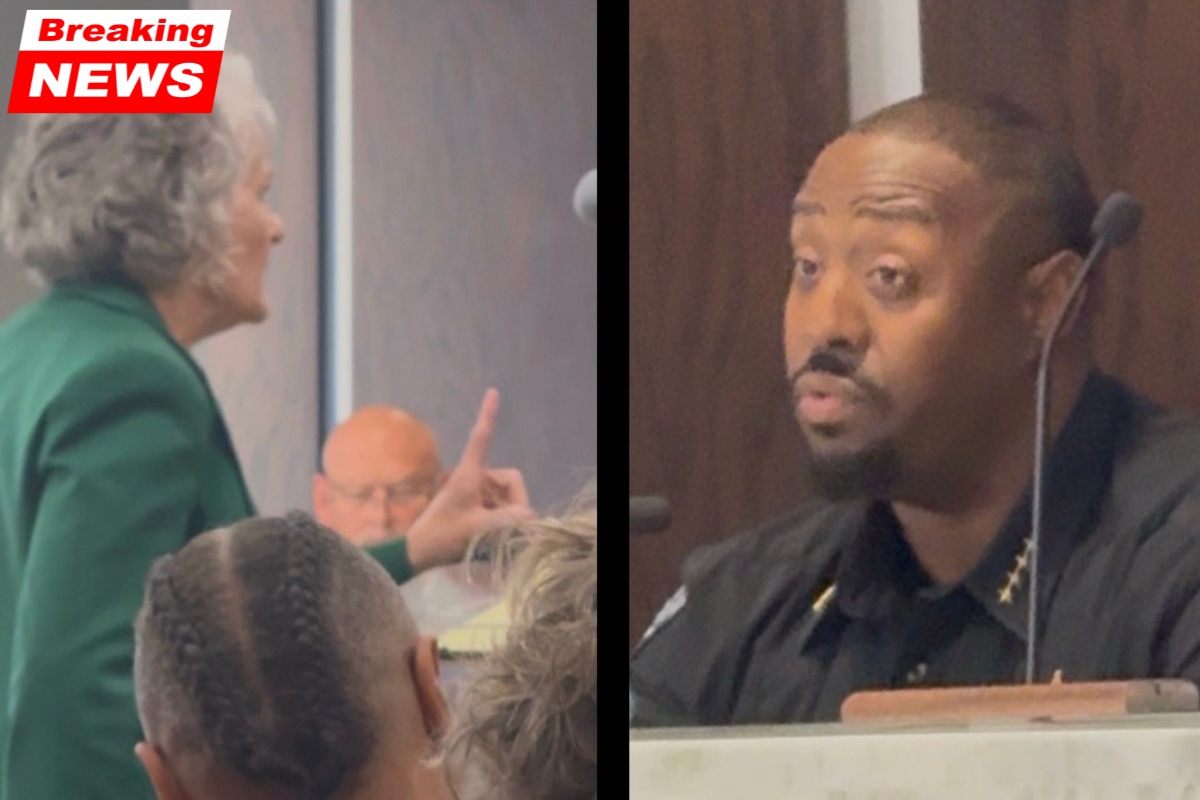
Oklahoma County District Attorney Vicki Behenna and Sheriff Tommie Johnson III engaged in a heated exchange of words during a county jail trust meeting on Friday.
The dispute centered around the sheriff’s decision to stop providing jail transport services for detainees being transported to and from court, with both officials accusing each other of unethical conduct.
The Disagreement: Jail Transport Services
The tension began when Behenna read a letter she had sent to members of the jail trust, urging them to reject Sheriff Johnson’s decision to stop the transport services.
Behenna expressed concerns that if the sheriff’s office withdrew from providing transport, the detention center staff would not be properly trained or equipped to handle the responsibility.
“My fear is that if the detention center takes over operations of transport back and forth, that one, you do not have the staff available at the detention center to fulfill those roles,” Behenna said. She warned that reallocating detention officers for transport duties could lead to a shortage of officers available for critical tasks, such as conducting pretrial interviews and making release decisions.
Behenna also pointed out that other counties with jail trusts, including Comanche, Tulsa, Logan, and Pottawatomie counties, rely on their sheriff’s office to manage detainee transport due to safety concerns.
“The reason for that is for the safety of those detainees and the safety of the public where those people are being transported to and from us,” Behenna argued.
Johnson’s Response: Legal Disagreement and Accusations of Misrepresentation
Sheriff Johnson quickly responded, refuting Behenna’s arguments. He argued that state law supports his decision and criticized Behenna for presenting inaccurate information regarding other counties.
According to Johnson, Behenna’s claim that the sheriff’s office handles transport in all the other counties with jail trusts except Oklahoma County was incorrect, stating that the only county where her statement was partially accurate was Tulsa County.
“Perhaps the most concerning portion of this letter is the lack of research conducted by the DA before this was submitted for public view,” Johnson said, accusing Behenna of misrepresenting facts.
He went on to suggest that Behenna’s errors were not unintentional. “I must assume that this was intentional in this state to persuade this body to make an ill-informed decision to further the DA’s agenda,” Johnson added.
Personal Tensions and Allegations of Gender Bias
The exchange soon turned personal, with Behenna defending herself against Johnson’s accusations and expressing frustration over what she described as his “visceral reaction” whenever they interacted.
“My agenda is public safety and ensuring the safety of detainees that are in the detention center,” Behenna responded, trying to steer the conversation back to the issues at hand.
“That’s my only agenda. So I don’t understand your visceral reaction to me. Every time we’re in the same room together.”
Behenna also suggested that Johnson’s reactions may be influenced by gender bias, implying that her concerns were being dismissed because of her role as a woman in a leadership position.
The Legal Debate: Sheriff’s Responsibility and State Law
The legal aspects of the disagreement stemmed from differing interpretations of the sheriff’s role in transporting detainees.
While Behenna cited the indenture that created the jail trust, which she believed mandated the sheriff’s involvement in transport, Johnson countered with state law, which he argued provided him the legal authority to discontinue the service.
The dispute highlighted the complexity of managing jail trusts and the need for clear policies regarding responsibilities and legal obligations.
Looking Ahead: The Need for Resolution
As the debate grew more personal and heated, it became clear that both officials have differing views on the best approach to jail transport and safety.
The conflict between Behenna and Johnson underscores broader issues within the county’s criminal justice system, particularly regarding the allocation of responsibilities between the sheriff’s office and the jail trust.
Moving forward, it will be crucial for both parties to find common ground to ensure that detainees are safely transported while also addressing the concerns raised about staffing and training.
Tensions Remain High
This exchange between Oklahoma County’s District Attorney and Sheriff has revealed deep divisions between two of the county’s top law enforcement officials.
While the issue at hand involves legal and logistical concerns, the personal tensions between Behenna and Johnson suggest that the road to a resolution may be fraught with challenges.
The next steps will be critical in determining how the county handles detainee transport and whether further changes to jail trust operations are needed.






