
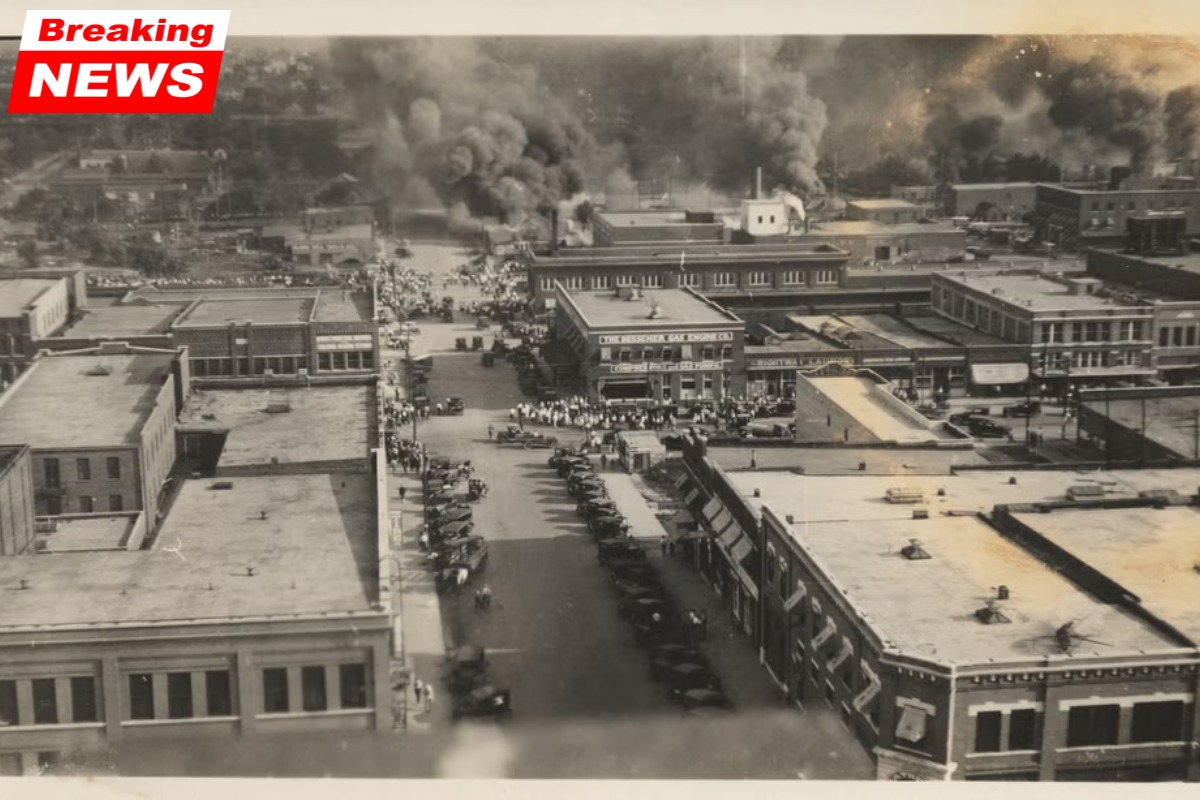
FAYETTEVILLE, OKLA. — In his new book, Damario Solomon-Simmons, a civil rights attorney and advocate for reparations, dives deep into the battle for justice for the survivors and descendants of the 1921 Tulsa Race Massacre.
His work highlights the struggles of those who continue to fight for reparations and accountability for the horrific events that devastated Greenwood, a thriving Black community once known as Black Wall Street.
A Personal Journey into the Past
Solomon-Simmons, a Tulsa native, didn’t learn about the massacre until his junior year of college, when his African American studies professor introduced the topic. Initially, he was skeptical and even denied the events that had shaped the city he grew up in. “I’m from Tulsa. That’s not true,” Solomon-Simmons recalled telling his professor, but soon learned he was wrong.
This realization sparked his passion for justice, leading him to pursue reparations for the massacre survivors and their families. Despite nearly 105 years having passed since the massacre, those who suffered have not been compensated, and the perpetrators have not been held accountable.
The Destruction of Greenwood
The Tulsa Race Massacre, which occurred over two days in 1921, left Greenwood in ruins. White mobs, fueled by racist rage, destroyed 35 city blocks of a prosperous and thriving Black community.
An estimated 191 businesses were lost, and around 11,000 Black residents were displaced. The official death toll was initially listed as 36, but historians argue the true number of deaths could range from 75 to 300.
At the time, Greenwood was a beacon of Black entrepreneurship and success, with businesses ranging from grocery stores to soda fountains, movie theaters, and even music venues.
Solomon-Simmons believes that ignoring the history of Greenwood and its importance in Black American culture allows America to ignore the systemic issues that still affect Black communities today.
“If you can ignore Greenwood, which was the beacon of Black prosperity and Black progress in the history of this country, then you can ignore Black people in general,” Solomon-Simmons said.
The Fight for Reparations
Solomon-Simmons’s book, Redeem a Nation: The Century-Long Battle to Restore the Soul of America, is not just an account of the Tulsa Race Massacre but also a call for reparatory justice. The book lays out the case for reparations for both the slavery of African Americans and the Tulsa massacre and urges the nation to reckon with its historical sins.
“The struggle for justice in Greenwood is not about returning to a mythical past. It is about proving whether America can build a soul at all through truth, through justice, through repair,” Solomon-Simmons writes.
The issue of reparations has been a subject of debate since the end of Reconstruction and remains contentious today. Opponents argue that no living culprits or victims of slavery exist, but Solomon-Simmons disagrees.
He points out that while the perpetrators of the Tulsa Race Massacre may not be alive, the descendants of the victims still deserve reparations for the harm done.
“We know who did the massacre — the perpetrators are still living in Tulsa,” Solomon-Simmons says, highlighting the ongoing need for accountability.
Ongoing Legal Battles
In 2020, Solomon-Simmons led a lawsuit on behalf of 11 plaintiffs, including the last living survivor of the Tulsa massacre, 111-year-old Lessie Benningfield Randle.
The lawsuit was a historic attempt to bring justice to the victims of the massacre, but it faced significant legal obstacles.
In 2024, the Oklahoma Supreme Court dismissed the lawsuit, and in 2021, the Biden administration’s Justice Department released a report concluding that there was no further avenue for criminal prosecution regarding the massacre.
Despite the setback, the fight continues. Solomon-Simmons is determined to secure reparations for Randle and other descendants of the massacre victims, as well as the return of stolen land and the creation of educational programs to ensure the history of Greenwood is not forgotten.
In 2025, Tulsa’s first Black mayor, Monroe Nichols, endorsed Project Greenwood, a proposal to financially compensate Randle and fund a scholarship program for the descendants of the massacre’s victims. The proposal also includes making June 1 a day of remembrance for the Tulsa Race Massacre.
A Call for Acknowledgment and Justice
For Solomon-Simmons, the fight for reparations is not just about financial compensation but about acknowledgment. “People want justice, but people (also) want acknowledgment. They want to be seen. They want people to understand that something happened to them and their family, and they want an apology,” he says.
As the 250th anniversary of the United States’ founding approaches, Solomon-Simmons questions whether Americans can truly celebrate the nation’s accomplishments without reckoning with its history of slavery, racism, and violence against Black Americans.
A Moral Obligation
Solomon-Simmons’s work calls for the United States to confront its historical injustices and provide reparations for the victims of slavery and the Tulsa massacre. In doing so, he argues, America can begin the process of healing and reclaiming its soul.
“I do not mean restoring something that was once whole,” Solomon-Simmons writes in his book, “America has never had a soul.”
The battle for reparations continues, and with Solomon-Simmons’s tireless work, it is clear that the fight for justice is far from over.






