
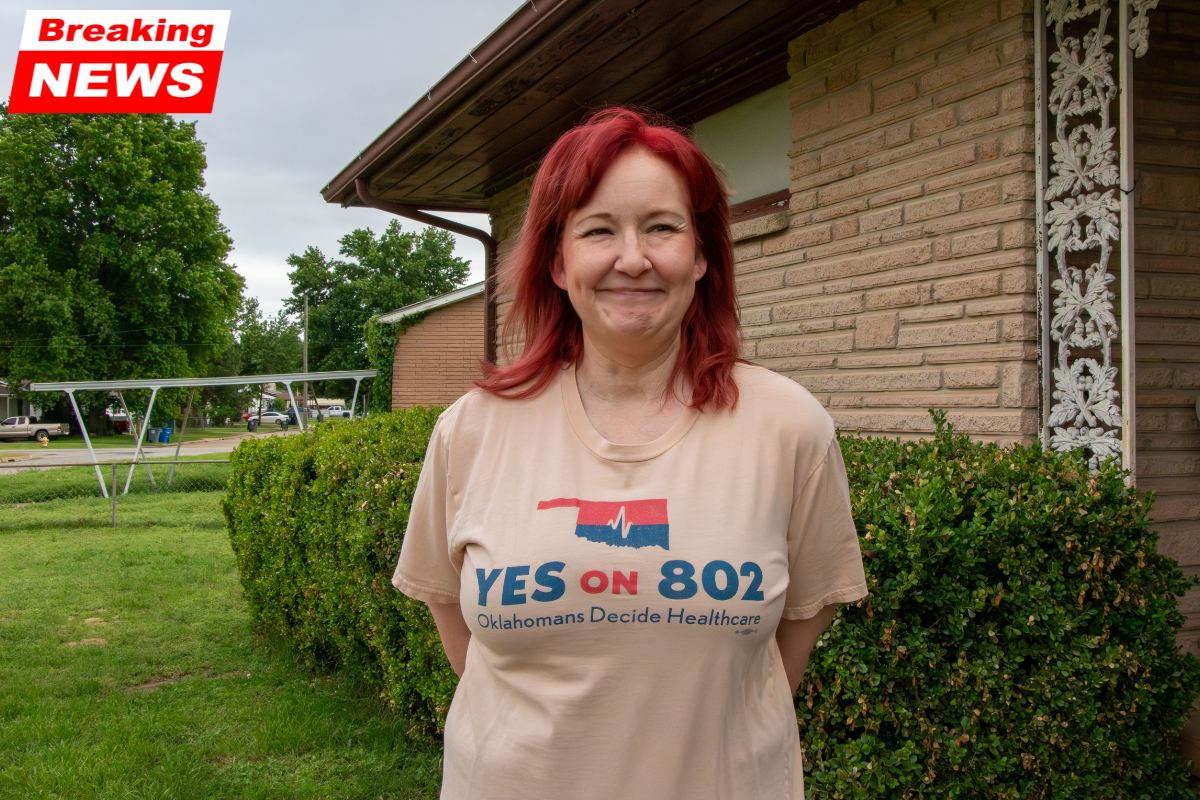
In 2020, Oklahomans approved State Question 802, expanding Medicaid eligibility to low-income residents, a decision that granted access to healthcare for over 233,000 Oklahomans.
However, less than five years later, Oklahoma Republicans are now seeking to remove Medicaid expansion from the state constitution and shift it to statute, potentially allowing it to be amended or repealed in the future.
A Voice for Medicaid Expansion: Kelly Smalley’s Story
Kelly Smalley, a Tulsa resident and single mother, became a strong advocate for Medicaid expansion after years of struggling with her health and caregiving duties.
Smalley has spent over two decades caring for her son, Nick, who has spina bifida and clubbed feet, and as a result, was unable to hold down a steady job.
The stress of caring for her son took a toll on Smalley’s health, eventually leading to her diagnosis of adult-onset epilepsy and multiple sclerosis.
When her son graduated from high school, Smalley lost her Medicaid coverage because Nick was no longer considered a dependent.
She faced years of uncertainty, battling to regain coverage while living with the fear of being unable to pay for medical care if something happened to her.
Smalley became an advocate for State Question 802 and worked to ensure that Medicaid expansion was enshrined in the state’s constitution, helping give thousands of Oklahomans access to healthcare.
Medicaid Expansion and Its Impact
State Question 802 expanded Medicaid eligibility to adults earning up to 138% of the federal poverty level, which is approximately $22,025.
The expansion allowed for 233,530 low-income Oklahomans to gain healthcare coverage, including essential services like hospital care, medication, and disease management.
However, with a looming budgetary concern, Republican lawmakers are now proposing changes that could unravel the expansion.
Governor Kevin Stitt, who has signed an executive order requiring a review of state-administered welfare programs, including Medicaid, has stated that the program needs reform to encourage self-sufficiency and reduce costs.
He believes Medicaid should focus on those truly in need, rather than those who could be working.
Republican Efforts to Roll Back Medicaid Expansion
In January, Stitt signed an executive order that initiated a review of welfare programs, including Medicaid. His administration aims to move Oklahomans from welfare to work and reduce state spending.
Days after the executive order, the Oklahoma Health Care Authority requested a nearly $500 million increase in its budget for the following fiscal year, raising concerns about the sustainability of Medicaid expansion.
In response, Republican lawmakers have introduced House Bill 4440 and House Joint Resolution 1067.
- HB 4440, introduced by House Speaker Kyle Hilbert and Senate Pro Tem Lonnie Paxton, would allow Oklahomans to vote on whether to remove Medicaid expansion from the state constitution and move it into statute, where it could be amended or repealed if federal financial support drops below 90%. Currently, the federal government covers 90% of Medicaid expansion costs, with the state covering the remaining 10%.
- HJR 1067, introduced by Rep. Ryan Eaves and Sen. Julie Daniels, would give lawmakers the power to choose not to cover Medicaid expansion if the federal match rate decreases.
The state legislature argues that these changes are necessary to better manage Medicaid spending, but many critics worry that they will result in cuts that could leave hundreds of thousands of Oklahomans without coverage.
National Context: Other States Facing Medicaid Challenges
Oklahoma isn’t alone in facing these challenges. Other states with constitutional amendments protecting Medicaid expansion, like South Dakota and Missouri, are also considering measures to scale back expansion.
In South Dakota, lawmakers are seeking to place a measure on the November ballot that would invalidate the state’s Medicaid expansion if federal funding falls below the 90% match rate.
Similarly, Missouri lawmakers have proposed changes that would add work requirements for Medicaid enrollees.
Opposition to Changes: Medical and Policy Experts Speak Out
Medical professionals and policy experts are deeply concerned about the proposed changes to Medicaid expansion.
Dr. Sumit Nanda, former president of the Oklahoma State Medical Association, voiced his frustration with the idea of rolling back the program.
He pointed out that Medicaid expansion has led to improvements in key areas like maternal health and access to opioid addiction treatment.
From an economic standpoint, Dr. Nanda noted that Medicaid expansion has allowed people who were previously unable to access medical care to work and contribute to the tax base.
This has long-term benefits for the state’s economy, including reducing future healthcare costs.
Smalley’s Concern for the Future
Smalley, who once had to struggle without adequate healthcare coverage, expressed deep concern about the potential loss of Medicaid expansion. If the program were rolled back, she feared that people like her — who rely on Medicaid for life-saving treatments — would become sicker and face more expensive care down the line.
“If Medicaid expansion goes away, people won’t be able to get the meds they need or the treatments they need,” Smalley said. “They’re going to be sicker, and it will be way more expensive to help them.”
What’s Next?
The future of Medicaid expansion in Oklahoma is uncertain. House Bill 4440 and House Joint Resolution 1067 are still awaiting hearings, and lawmakers are divided on how to proceed.
Some Republicans want to scale back Medicaid expansion to gain more control over the system, while medical providers, health policy experts, and advocates for low-income Oklahomans are urging lawmakers to preserve the program.
If the issue goes to the November ballot, Oklahomans will have the final say on whether Medicaid expansion remains enshrined in the state’s constitution or whether it becomes subject to future changes that could leave thousands of people without access to healthcare.
For Smalley and the 200,000 Oklahomans who gained coverage, the stakes are high. They plan to show up at the polls to protect Medicaid expansion and the benefits it has brought to their lives.






