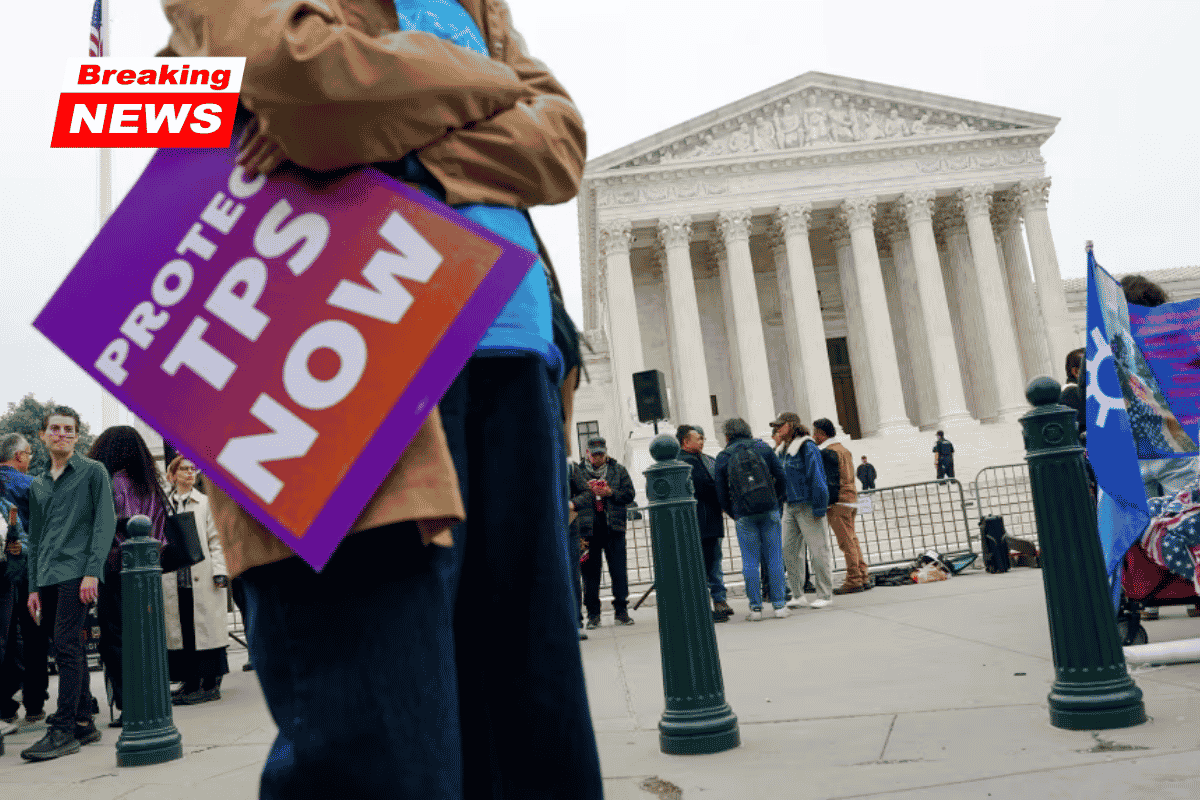
The Supreme Court of the United States has signalled that it may support Donald Trump’s plan to end special deportation protections for many immigrants. This could affect more than one million people currently living and working legally in the US under a programme called Temporary Protected Status (TPS).
The case is important because it may decide not only the future of these immigrants but also whether courts can review such government decisions at all.
What Is Temporary Protected Status (TPS)
TPS allows people from countries facing war, violence, or natural disasters to stay and work in the US for a limited time. It is meant to protect them until conditions improve in their home countries.
At present, over 1 million immigrants benefit from this programme.
Key Issue: Can Courts Review TPS Decisions?
One major question in the case is whether courts even have the authority to review decisions related to TPS.
Some conservative judges, including Chief Justice John Roberts, suggested that Congress may have blocked courts from reviewing these decisions.
Justice Samuel Alito also expressed doubt that the challengers could succeed if past interpretations of the law are followed.
Lawyers representing immigrants argued that while the final decision may not be reviewed, the process used to reach it should still be open to legal challenge.
However, Justice Amy Coney Barrett questioned this idea, asking why the process should be reviewed if the final decision itself cannot be.
Debate Over Discrimination Claims
Another important issue is whether the decision to end TPS for certain countries was influenced by discrimination.
Liberal justices, including Sonia Sotomayor, pointed to past controversial comments made by Trump about countries like Haiti.
She questioned whether such remarks showed bias in the decision-making process.
Justice Ketanji Brown Jackson also raised concerns, asking how the court could ignore these statements when lower courts had considered them important.
The government’s lawyer, D. John Sauer, argued that those comments were made in different contexts and should not affect the case.
Notably, conservative judges mostly avoided discussing these comments during the hearing.
Focus on Syria’s Situation
Justice Brett Kavanaugh looked closely at the situation in Syria.
He pointed out that the previous government in Syria had fallen in 2024, suggesting that conditions in the country may have changed.
This could support the argument that TPS is no longer needed for Syrian nationals.
However, lawyers for immigrants said the situation is still complex and not fully safe, and they argued that the government did not properly review the conditions before ending protections.
Disagreement Over Government Process
Another key debate was about whether the Department of Homeland Security followed the correct process.
The law requires consultation with the State Department before ending TPS. But lawyers for immigrants said this consultation was not meaningful.
Justice Elena Kagan strongly questioned the government’s argument. She gave examples suggesting that simply asking for input is not enough if no proper response is given.
The government insisted that even minimal communication meets the legal requirement.
Why This Case Matters
The court’s final decision, expected soon, could have a wide impact:
- It may affect TPS holders from multiple countries, not just Haiti and Syria
- It could limit the power of courts to review government immigration decisions
- It may influence other ongoing cases related to immigration policies
Earlier, the court had already allowed the removal of protections for some Venezuelan immigrants without explaining its reasoning.