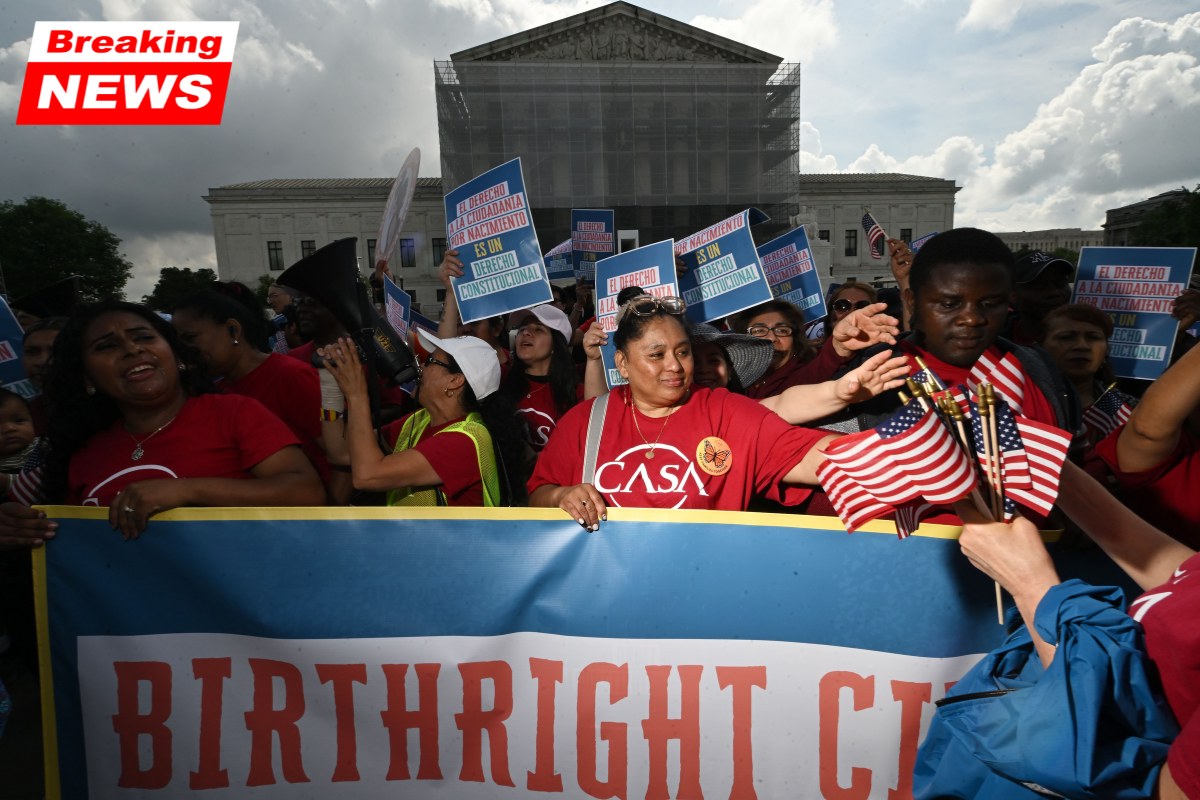
The debate surrounding President Donald Trump’s executive order on birthright citizenship is heating up as the Supreme Court prepares to hear arguments regarding the order’s legality. At the heart of the case is the fundamental question of whether birthright citizenship, as enshrined in the 14th Amendment, can be reinterpreted by executive order.
This case raises not only constitutional and historical concerns but also practical questions about how such a policy would be implemented if it were to take effect.
Kavanaugh’s Hard-Hitting Questions: A Key Window Into the Court’s Concerns
Justice Brett Kavanaugh, often known for his more measured approach, took a very direct line of questioning during last year’s arguments, which shed light on the potential difficulties of implementing Trump’s proposed changes.
He asked key questions like:
- “Would hospitals have to change the way they process newborns?”
- “Would state governments have to do something different?”
- “How would federal officials determine citizenship if a birth certificate no longer sufficed?”
These questions point to significant logistical challenges that would arise if the executive order were to be enforced, especially considering how much of the U.S. citizenship system currently relies on birth certificates as proof of citizenship.
The Focus of the Supreme Court’s Debate
The Supreme Court’s review will focus primarily on historical interpretation of the 14th Amendment’s citizenship clause, which grants automatic citizenship to those born in the U.S., provided they are “subject to the jurisdiction thereof.” Both Trump’s administration and the groups opposing the policy will present arguments regarding the framers’ original intent.
The government argues that the amendment was designed to guarantee citizenship to the children of freed slaves, not to people temporarily in the country illegally.
However, as Kavanaugh’s questioning demonstrates, even if the court rules in favor of the executive order, the practical implementation of the policy could create a bureaucratic nightmare. Federal agencies would need to figure out how to accurately track and verify the citizenship status of parents and their children, which could result in legal chaos.
Implementation Challenges: A Tidal Wave of Confusion
If the policy were allowed to take effect, many experts predict that it would lead to a “tidal wave of legal confusion”. Jill Habig, the CEO of the Public Rights Project, argues that trying to change such a long-standing part of the Constitution with an executive order could destabilize the U.S. citizenship system.
Birth certificates, she notes, are currently the cornerstone of proving citizenship in the U.S., and the shift away from this could create widespread confusion.
The State Department has begun issuing guidelines to explain how this policy might be implemented, including the requirement that parents prove their own legal status to obtain a passport for their child.
However, these documents have raised even more questions. For example, if the Social Security Administration relies on a database that is known to be inaccurate, how can it be trusted to accurately determine a child’s citizenship?
Impact Beyond the Targeted Group
Though the policy is ostensibly aimed at “birth tourists”—immigrants who come to the U.S. specifically to give birth—the broader implications could be far-reaching. Critics argue that the policy would fundamentally alter the nature of U.S. citizenship by shifting it from being geographically based (as in “born on U.S. soil”) to one based on parentage.
This could strip the children of immigrants who have lived in the U.S. for years of their citizenship, causing them to struggle to prove their legal status, even if they have lived their whole lives as Americans.
Comparisons to the UK: A Warning?
Trump’s administration has pointed to other countries, such as the United Kingdom, which abolished automatic birthright citizenship in 1983. However, critics argue that, in the case of the UK, the law was passed through Parliament, not by executive order.
The Windrush scandal, in which immigrants from the Caribbean and their descendants were unable to prove their citizenship, highlights how such a shift in policy can result in bureaucratic difficulties and legal confusion.
The 14th Amendment: A Source of American Identity
At its core, the dispute over birthright citizenship represents a larger question of what it means to be American. Vikram Amar, a professor at the University of California, argues that birthright citizenship reflects the American experiment—the idea that opportunities and rights should be based on an individual’s equality and potential, not their bloodline or family history.
This argument underscores why birthright citizenship has been such a cornerstone of U.S. identity for over a century. To change it would not only require a legal redefinition but also a profound rethinking of the principles that have guided the nation since its founding.
Looking Ahead: What Will the Court Decide?
The Supreme Court’s decision on Trump’s executive order is expected by the end of June 2026. While the conservative majority on the Court could lean in favor of upholding the order, Kavanaugh’s intense questioning and concerns about its practical implementation suggest that even some justices in the conservative wing recognize the potential for chaos that the policy could cause.
This decision will have long-lasting implications for the future of U.S. citizenship and how Americans define who belongs to the nation. Regardless of the outcome, the debate surrounding birthright citizenship will likely continue to be a divisive and foundational issue in U.S. politics for years to come.