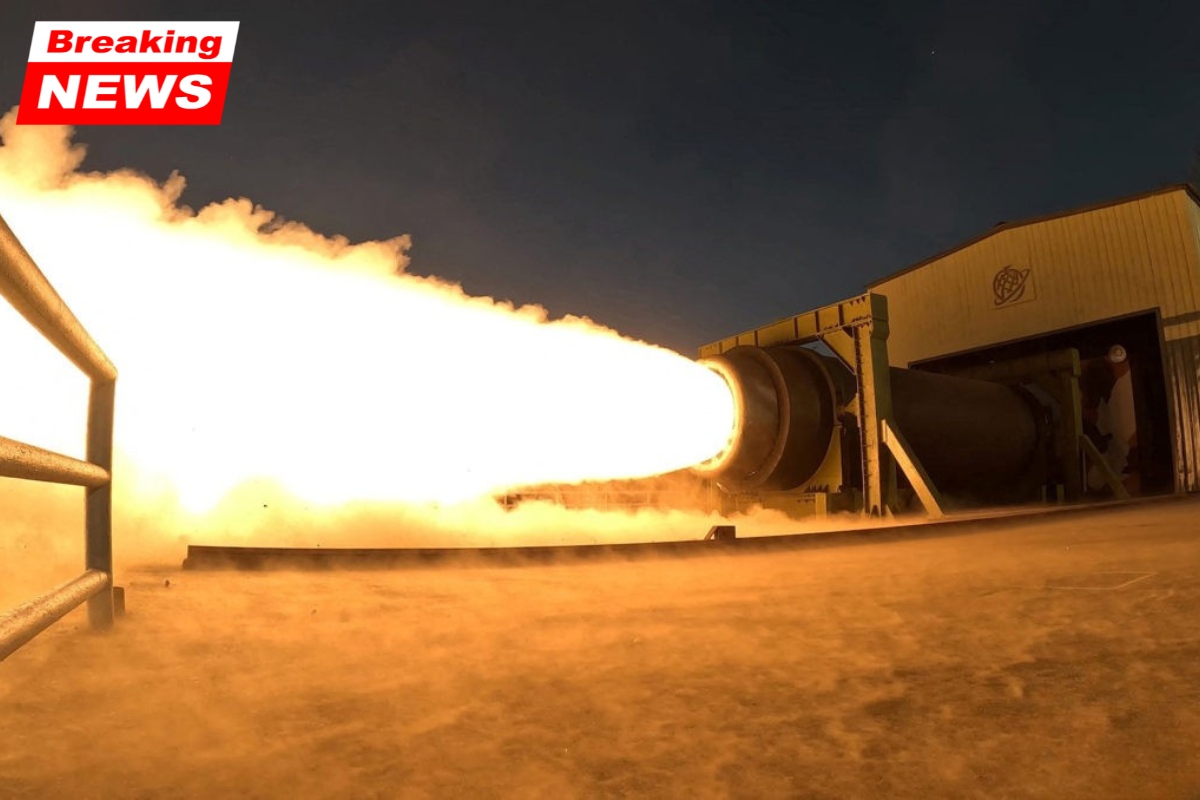
North Korea’s leader Kim Jong Un recently observed a test of an upgraded solid-fuel engine designed for missiles capable of potentially reaching the U.S. mainland. The development, announced through state media, is part of Kim’s broader strategy to enhance his country’s military capabilities, particularly in terms of more agile and harder-to-detect missile systems.
Upgraded Solid-Fuel Engine Test: Key Details
Kim Jong Un’s observation of the test was reported by the official Korean Central News Agency (KCNA), which emphasized the significance of the engine’s improvements. The engine, made with composite carbon fiber material, demonstrated a maximum thrust of 2,500 kilonewtons—a notable increase from the 1,970 kilonewtons seen in a similar test conducted last September.
- Solid-fuel engines offer strategic advantages over liquid-fuel ones, including easier mobility and concealment. They are faster to deploy since they do not require pre-launch fueling, which makes them harder to detect and more versatile.
- This engine test is part of North Korea’s five-year arms build-up, aimed at enhancing its “strategic strike means,” particularly nuclear-capable ballistic missiles.
Expert Skepticism: Could North Korea Be Bluffing?
While North Korea’s report paints a picture of great progress, some experts have raised doubts about the full implications of the test.
Lee Choon Geun, an honorary research fellow at South Korea’s Science and Technology Policy Institute, expressed skepticism, pointing out that important details, such as the engine’s total combustion time, were not disclosed.
This omission could signal that North Korea is exaggerating the significance of the test or facing technical challenges with its solid-fuel program.
- The September test was presented as the final test of the engine, with experts anticipating an imminent test-launch of an intercontinental ballistic missile (ICBM) powered by the new engine. However, North Korea has not yet followed through on these expectations.
Delays and Possible Assistance from Russia
Experts speculate that delays in the solid-fuel engine program may be due to technical difficulties or the country’s decision to pursue an improved version of the engine.
Some believe that North Korea could be receiving Russian assistance in this area, as relations between the two nations have strengthened in recent years. North Korea has provided support for Russia’s war in Ukraine, which could signal increased military cooperation.
Technological Hurdles and Potential for ICBM Development
Despite North Korea’s claims and persistent missile tests, the country still faces technological challenges in perfecting a fully functional ICBM. One major obstacle is ensuring that the warheads can survive the harsh conditions of atmospheric reentry, which is a critical step in developing a reliable long-range missile capable of striking the U.S. mainland.
Nonetheless, experts agree that solid-fuel engines would make it easier for North Korea to develop smaller ICBMs that can be launched from mobile trucks or submarines, making them more difficult to target. Additionally, the push for higher engine thrust could be linked to efforts to increase missile payloads, such as deploying multiple warheads on a single missile to overwhelm U.S. defense systems.
North Korea’s Increasing Nuclear Arsenal
North Korea has been expanding its nuclear and missile capabilities ever since its diplomacy with U.S. President Donald Trump collapsed in 2019. In February 2024, Kim Jong Un left the door open for future talks with Washington but insisted that the U.S. must drop its demands for North Korea’s nuclear disarmament before any serious discussions could take place.
- Hwasong-20 missiles, which North Korea described as its “most powerful nuclear strategic weapon system,” were showcased during a military parade in October 2025. These missiles highlight the growing potency of North Korea’s arsenal, further raising concerns about its long-range missile capabilities.
Global Concerns and Implications
The recent test of a more powerful solid-fuel engine aligns with North Korea’s ongoing push to bolster its military deterrence, particularly with an eye on deterring U.S. and allied threats. While there is considerable international skepticism over some of North Korea’s claims, the test demonstrates continued advancements in the country’s nuclear and missile programs. These developments have significant implications for regional security and global nonproliferation efforts.
North Korea’s growing missile capabilities, if proven effective, could pose a more direct and immediate threat to the U.S. and its allies. The country’s pursuit of improved solid-fuel engines is a clear indication that it intends to build a more sophisticated and flexible strategic arsenal, one that could challenge existing defense systems and alter the military balance in the region.