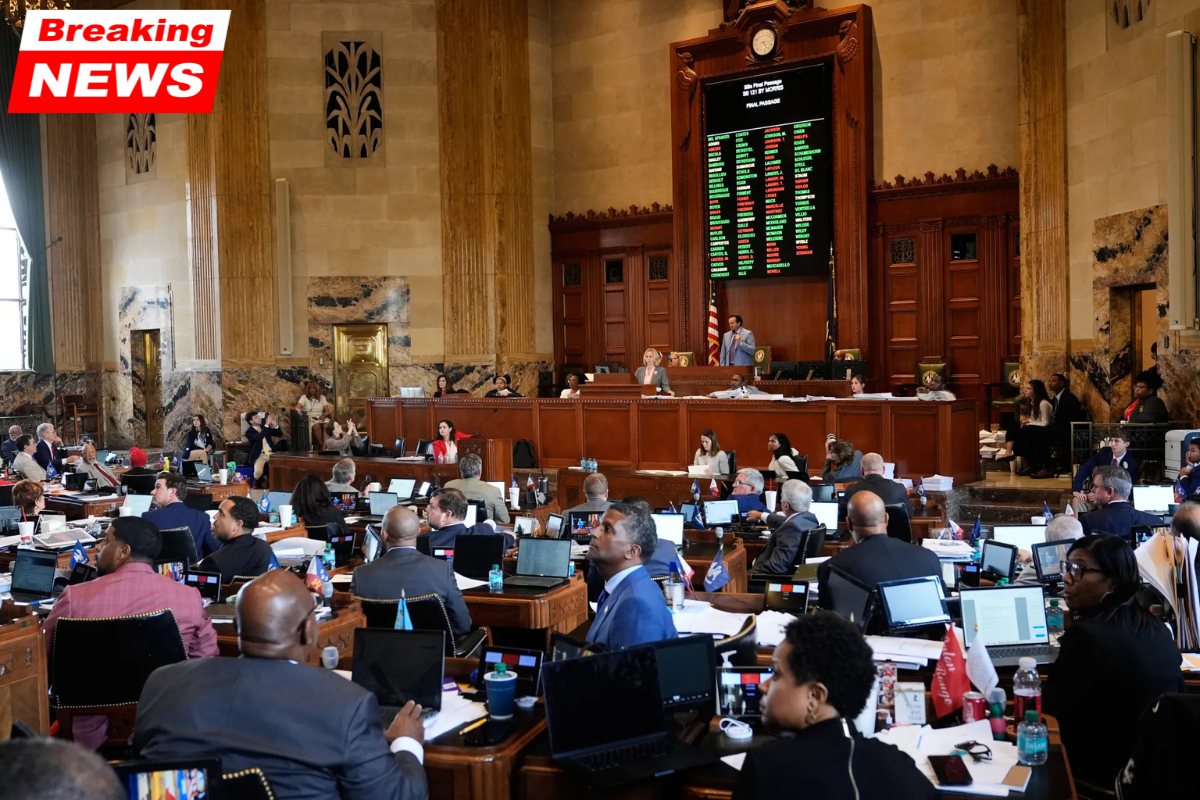
Louisiana lawmakers on Friday approved a new congressional map that could allow Republicans to flip one of the state’s two Democratic-held House seats in the 2026 midterm elections.
The Louisiana Senate gave final approval to the bill despite significant dissent from Democratic lawmakers, who argued the map is flawed and likely to face legal challenges.
State Senator Royce Duplessis, a Democrat, voiced concerns on the Senate floor, saying, “Y’all, at the beginning of this process, I would have said that we are building a house on a broken foundation.
Now, it feels more like quicksand, because we’re in 2026 going into a map that we know is flawed, that we know is going to get struck down.”
Republicans Defend the New Map
State Senator Jay Morris, a Republican, defended the map ahead of the final vote, arguing it meets all traditional redistricting criteria. “I think we have a map here that meets all the traditional redistricting criteria.
It’s not racially gerrymandered. … I think it broadly allows for representation for each region of the state, and it’s very fair, and we should approve it,” Morris said.
The approval follows a Supreme Court decision striking down Louisiana’s previous map as an unconstitutional racial gerrymander.
This ruling required mid-decade redistricting and has sparked nationwide concerns among Democrats about potential reductions in Black congressional representation.
Supreme Court Decision and Redistricting Implications
The Supreme Court ruling on Louisiana’s prior map dealt a blow to Section 2 of the Voting Rights Act, prompting the state to redraw congressional districts.
Democrats warn that the new map, which eliminates one of the two majority-Black districts in Louisiana, could reduce opportunities for Black voters to elect candidates of their choice.
During extended floor debate, Democratic representatives expressed frustration over the redistricting process.
State Representative Kyle Green, a member of the Louisiana Legislative Black Caucus, argued against claims that congressional maps should now be “colorblind.” He said, “I want to ask you to remember the argument that we should now be colorblind about a congressional map, in this state of all states, requires forgetting a quantity of history that I don’t believe any of us has the right to forget. Black people in this country were not citizens; not partial citizens, not second-class citizens. We weren’t citizens at all.”
Republican Perspective on the Map
State Representative Beau Beaullieu, a Republican and sponsor of an amended version of the map, defended the new districts by referencing the Supreme Court ruling. He argued that legislators were forced to redraw the map after the court struck down the previous one.
Beaullieu explained, “And now we find ourselves back with a similar map to the one this body passed in 2022, that had five Republican districts and one Democrat district.
The map complies with traditional redistricting principles and also maximizes partisan advantage. The map is contiguous; it is compact; it binds communities of interest; it protects incumbency. … Race was not a factor when drawing these districts.”
Impact on Louisiana Elections
The newly approved map is expected to shift political power in Louisiana ahead of the 2026 midterms. By potentially flipping a Democratic-held seat, Republicans aim to strengthen their congressional presence in the state.
The map’s elimination of a second majority-Black district has become a focal point of debate, with critics arguing it undermines fair representation for Black voters.
Summary Table of Key Facts
| Aspect | Details |
|---|---|
| Legislative Body | Louisiana Senate and House |
| Map Approval Date | Friday, 2026 |
| Key Issue | Redistricting after Supreme Court ruling |
| Political Impact | Potential flip of one Democratic-held House seat |
| Democratic Concerns | Eliminates one majority-Black district, likely reduces Black representation |
| Republican Defense | Map meets redistricting criteria, contiguous, compact, binds communities of interest, protects incumbency |
| Supreme Court Ruling | Struck down prior map as racial gerrymander, limits Section 2 of Voting Rights Act |
| Debate Highlights | Democrats warn of historical and racial implications; Republicans focus on legal compliance and fairness |
Louisiana’s new congressional map highlights ongoing tensions over redistricting and racial representation. While Republicans defend the map as legally compliant and fair, Democrats argue it undermines the political power of Black voters and could reduce minority representation in Congress.
With the 2026 midterms approaching, the map’s implications for electoral outcomes and civil rights remain significant, and legal challenges may arise as the state moves forward under the revised districts.