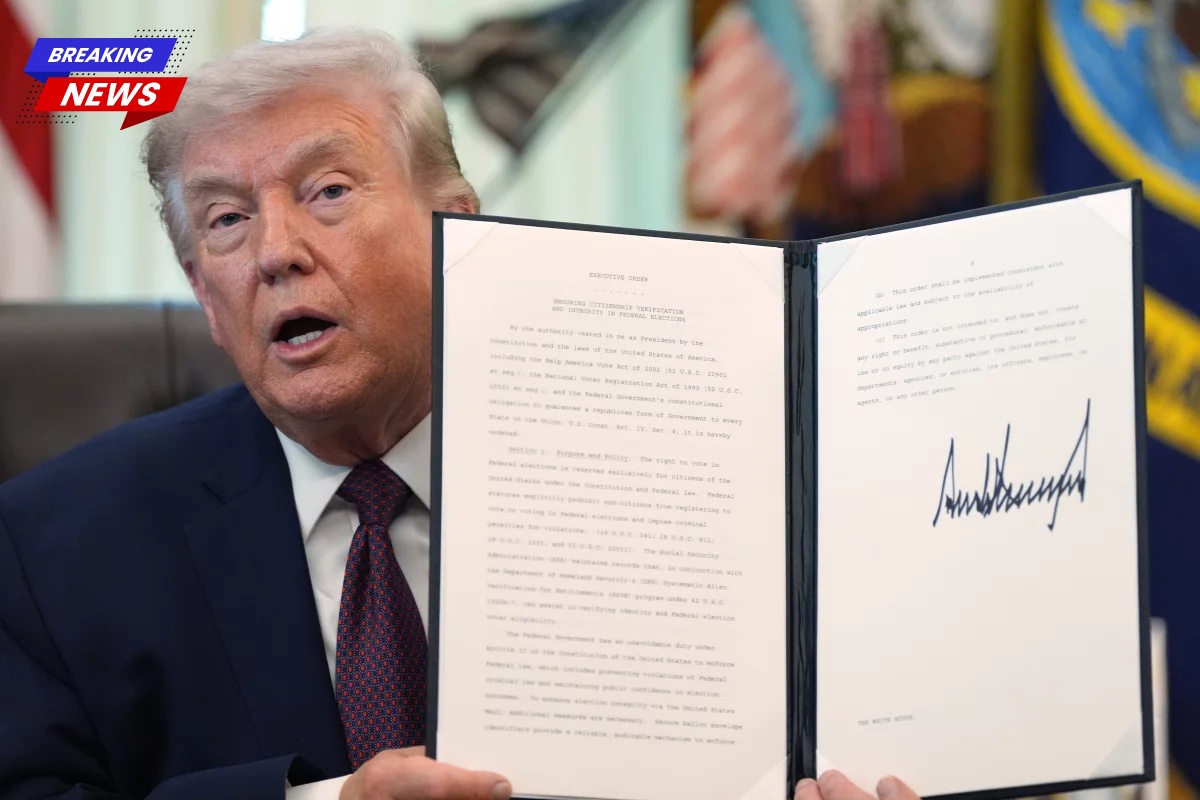
A federal judge has declined to temporarily block President Donald Trump’s executive order that seeks to restrict voting by mail, leaving the order in place for now.
The decision, issued by U.S. District Judge Carl Nichols, a Trump appointee based in Washington, D.C., tests the boundaries of presidential authority under the U.S. Constitution. Notably, a previous executive order on voting in 2025 had been halted by the courts.
The latest order, issued on March 31, directs the Department of Homeland Security to collaborate with the Social Security Administration to create lists of adult U.S. citizens in each state. These lists would then be shared with state election officials.
Additionally, the U.S. Postal Service (USPS), an independent federal agency, is instructed to generate its own list of eligible voters and deliver mail-in ballots only to individuals on those lists.
Judge Nichols’ Ruling and Rationale
Judge Nichols ruled that it is premature for the court to issue an emergency injunction against Trump’s order because the directives have not yet been implemented.
“The Court recognizes that the Postal Service may ultimately issue a final rule that directly affects Plaintiffs or their members, or that the Government may develop State Citizenship Lists that omit specific individuals due to particularized flaws. Plaintiffs may, of course, renew their motions if and when those future actions occur. Until then, however, Plaintiffs cannot show that preliminary injunctive relief is warranted,” Nichols wrote in his decision.
This ruling comes as another federal judge in Boston prepares to rule on similar lawsuits, potentially as early as June.
Political Reactions to the Executive Order
Democratic lawmakers and voting rights groups have strongly criticized Trump’s order. Senate Democratic leader Chuck Schumer called it “voter suppression, plain and simple” and reaffirmed Democrats’ commitment to protecting voting rights.
Danielle Lang, an attorney at the Campaign Legal Center, emphasized that challengers, including the League of United Latin American Citizens, “look forward to the next stage of this litigation.” She added that the administration is attempting to “unlawfully shape the electorate” but that legal teams will continue to challenge the order.
Implementation Uncertainty
Since the order was signed, its real-world impact on mail-in voting has remained unclear. During state primaries earlier this year, mail-in voting proceeded as usual. In early May, federal agencies admitted in court filings that they were still deliberating how to execute the order.
Acting U.S. Attorney General Todd Blanche stated before a Senate subcommittee that the Justice Department is coordinating with other agencies to “make sure” the order’s directives are implemented.
Trump’s order also called for Postmaster General David Steiner to initiate a rulemaking process by late May. However, as of the latest reports, the USPS had not released any public notice regarding this process. Spokespeople for the USPS did not immediately respond to inquiries.
Legal Challenges to the Executive Order
Opponents of the order, including nearly two dozen states and Washington, D.C., have filed five lawsuits challenging it. They argue that the Constitution grants state legislatures and Congress—not the president—the authority to set rules for federal elections. Plaintiffs also contend that the executive order directs USPS to make rules about election mail, exceeding its statutory authority.
Trump has defended the order as a measure to prevent illegal voting by noncitizens, although studies show such incidents are exceedingly rare. Mail-in voting is widely used across party lines, though more Democrats than Republicans reported voting by mail in the 2024 national election.
Summary Table: Key Points of Trump’s Executive Order and Legal Status
| Feature | Details | Status |
|---|---|---|
| Issued | March 31, 2026 | Active (temporarily allowed by Judge Nichols) |
| Agencies Involved | Department of Homeland Security, Social Security Administration, USPS | Coordinating implementation |
| Main Directives | 1. Create adult citizen lists per state 2. USPS to deliver ballots only to eligible voters | Not yet fully executed |
| Legal Challenges | 5 lawsuits, including D.C. and Boston cases | Ongoing |
| Constitutional Argument | Plaintiffs argue president exceeds authority over federal elections | Pending appeals possible |
| Political Reaction | Democrats call it voter suppression; Trump cites election integrity | Highly controversial |
Judge Nichols’ decision highlights the legal complexity surrounding presidential influence on elections. While Trump’s executive order remains temporarily in place, its practical effects are still uncertain, and multiple lawsuits are actively challenging its constitutionality. The issue underscores ongoing tensions over mail-in voting and the limits of executive power, with the courts poised to play a decisive role in determining the outcome.