
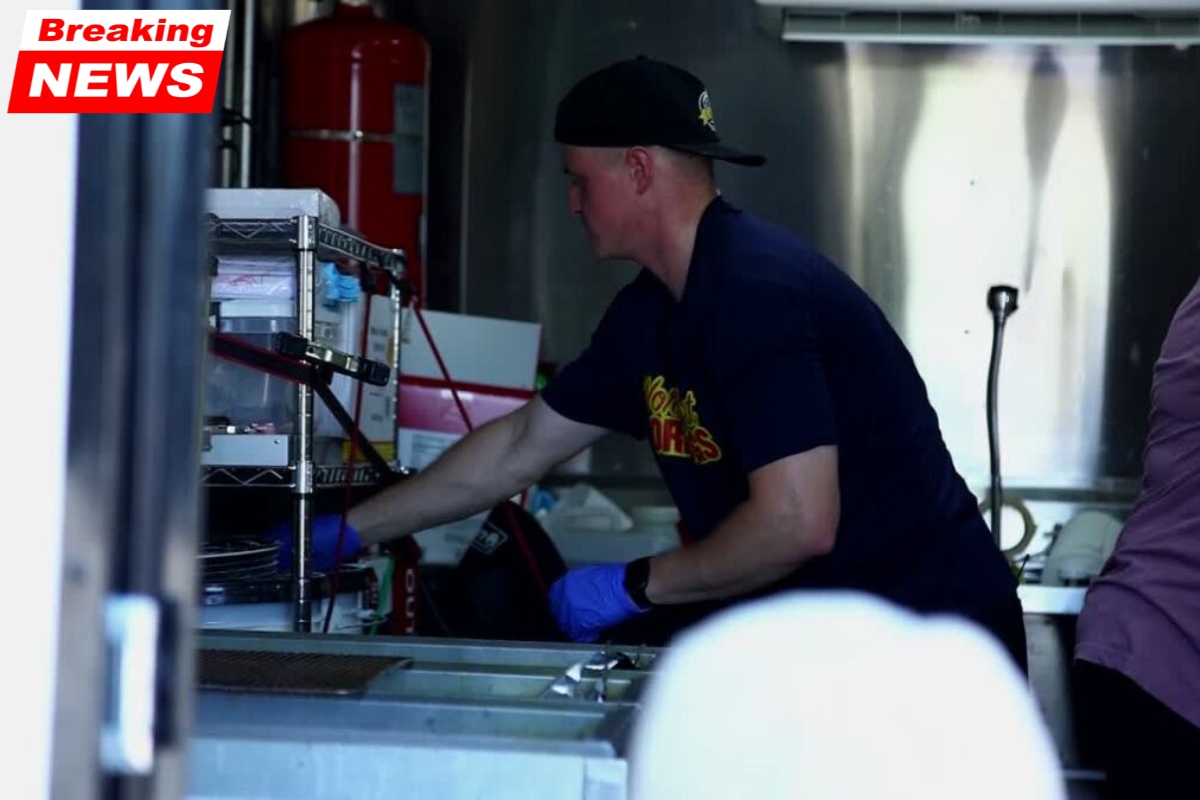
Governor Kevin Stitt signed House Bill 3369 on May 12th, a measure that will take effect on November 1st and offer food truck operators additional flexibility regarding fire safety requirements.
The bill allows food truck owners to comply either with a full fire suppression system or by equipping their truck with two Class K fire extinguishers.
The legislation was filed by Representative Derrick Hildebrant, a Republican from Catoosa, and Senator Christi Gillespie, a Republican from Broken Arrow.
Changes Introduced by HB 3369
HB 3369 modifies previous fire safety regulations by providing an alternative to the mandatory automatic fire suppression system.
Representative Hildebrant explained that the option of two Class K fire extinguishers—one positioned at the front and one at the rear of the truck—offers a practical and common-sense approach.
This option addresses concerns that fire suppression systems could inadvertently discharge near high-temperature cooking equipment, such as vats of hot oil, potentially endangering operators.
The new bill builds on regulations that took effect earlier this year on January 1st, which required multiple safety upgrades for food trucks, including electrical wiring improvements, plumbing adjustments, and installation of vent hoods.
While these upgrades were generally supported, the mandatory fire suppression system created additional challenges and costs for operators. Hildebrant noted that some systems could cost thousands of dollars, a burden especially for long-standing trucks retrofitting older equipment.
Impact on Food Truck Owners and Operators
Food truck operators welcomed the change, highlighting the benefits for both safety and affordability. Kenton Hartle, owner of “Worlds Best Corndogs,” operates a truck equipped with a fire suppression system over his three fryers.
While the updated law will not affect him directly, he recognized how the requirement had posed challenges for older food trucks that were not originally built with suppression systems.
Hartle emphasized that his primary goal is to prevent fires from occurring, noting that the suppression system serves as a precaution rather than a tool he expects to use regularly.
He acknowledged that a similar requirement imposed on his truck two years ago would have been a significant operational and financial challenge.
Representative Hildebrant stated that HB 3369 was developed collaboratively with the Fire Protection Association, fire chiefs, and the State Fire Marshal.
The bill also simplifies the permitting process through the Oklahoma Liquefied Petroleum Gas Board and the State Fire Marshal, making compliance more straightforward for operators while maintaining safety standards.
Table: HB 3369 Key Points for Food Truck Owners
| Aspect | Details |
|---|---|
| Bill | House Bill 3369 |
| Signed by | Governor Kevin Stitt, May 12th |
| Effective Date | November 1st |
| Sponsors | Rep. Derrick Hildebrant (R-Catoosa), Sen. Christi Gillespie (R-Broken Arrow) |
| Fire Safety Options | Full fire suppression system or two Class K fire extinguishers (front and rear) |
| Reason for Change | Provides flexibility, addresses safety concerns, reduces cost burden |
| Related Permits | Simplifies permitting via Oklahoma LP Gas Board and State Fire Marshal |
| Cost Implications | Fire suppression systems may cost thousands; extinguisher option is less costly |
| Collaboration | Developed with Fire Protection Association, Fire Chiefs, and State Fire Marshal |
House Bill 3369 provides Oklahoma food truck owners with greater flexibility while maintaining essential safety standards. By allowing operators to use two Class K fire extinguishers as an alternative to a full fire suppression system, the law reduces financial burdens and operational challenges.
Collaboration with fire safety professionals ensures that the updated regulations prioritize both operator safety and public protection. The law takes effect November 1st, giving operators time to adjust their equipment and comply with the new standards.






